SparkFun
SparkFun Pro Micro - RP2040
The SparkFun Pro Micro RP2040 is a low-cost, high performance board with flexible digital interfaces featuring the Raspberry Pi Foundation's RP2040 microcont...
Get notified when back in stock
- 264kB of embedded SRAM in six banks
- Six dedicated IO for SPI Flash (supporting XIP)
- 30 multifunction GPIO
- Dedicated hardware for commonly used peripherals
- Programmable IO for extended peripheral support
- Four channel ADC with internal temperature sensor, 0.5 MSa/s, 12-bit conversion
- USB 1.1 Host/Device
- Dual Cortex M0+ processors, up to 133 MHz
- 264 kB of embedded SRAM in 6 banks
- 6 dedicated IO for QSPI flash, supporting execute in place (XIP)
- 30 programmable IO for extended peripheral support
- SWD interface
- Timer with 4 alarms
- Real time counter (RTC)
- USB 1.1 Host/Device functionality
- Supported programming languages
- MicroPython
- C/C++
- Raspberry Pi Foundation's RP2040 microcontroller
- AP2112 3.3V voltage regulator
- Support programming languages
- MicroPython
- C/C++
- On-board USB-C connector for programming
- USB 1.1 Host/Device functionality
- Built-in Resettable PTC Fuse
- PTH pads w/ castellated edges
- 20x multifunctional GPIO Pins [1]
- 4x 12-bit ADC channels with internal temperature sensor, 0.5 MSa/s, 12-bit
- 10x PWM channels
- Serial Peripherals
- 2x UARTs
- 1x I2C (Qwiic enabled)
- 1x SPI
- Buttons
- Boot
- Reset
- LEDs
- Power
- WS2812 Addressable LED
- 16MB External Flash Memory
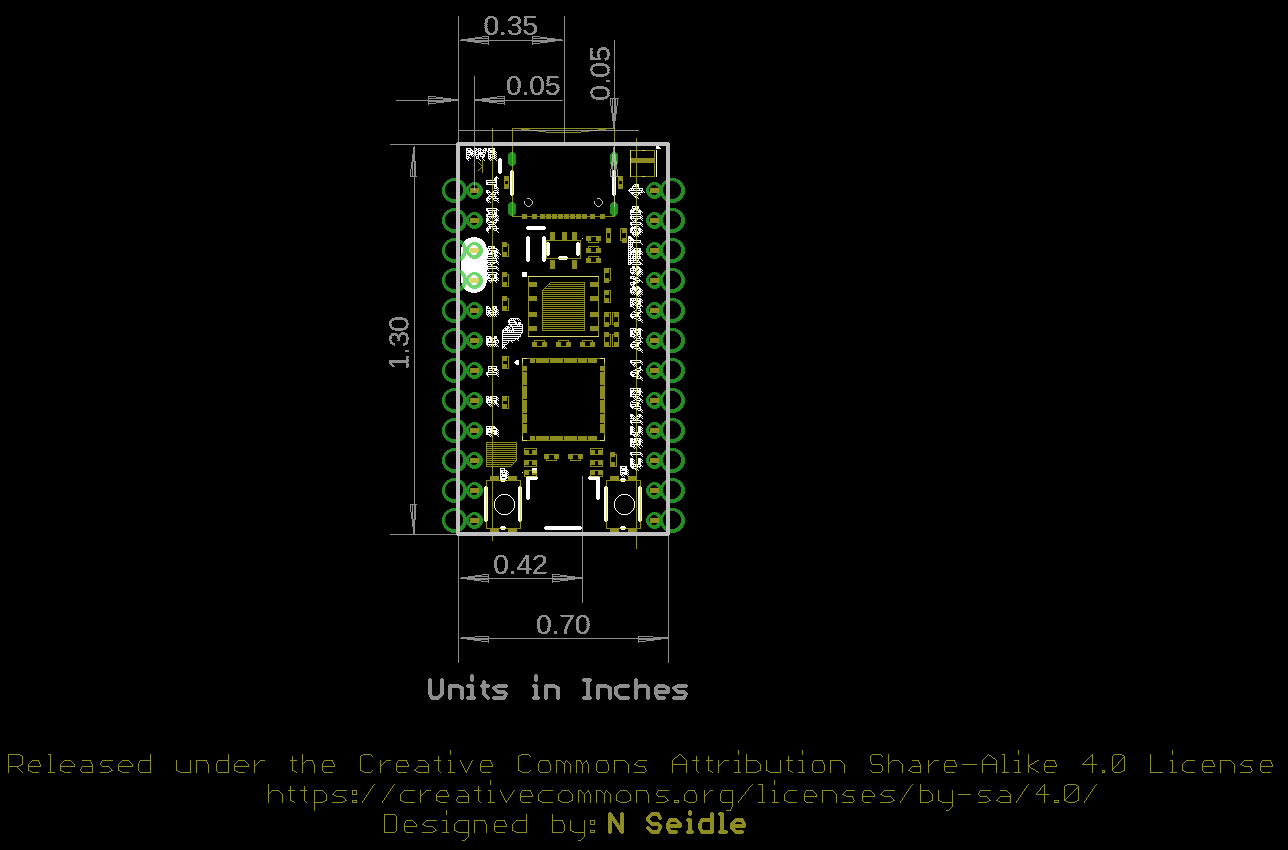
- Dimensions: 1.3in x 0.7in
- Schematic
- Eagle Files
- Board Dimensions
- Hookup Guide
- Graphical Datasheet
- RP2040 Datasheet (31.2 MB)
- Raspberry Pi Pico Datasheet (16.5MB) - An RP2040-based microcontroller board
- Getting Started with Raspberry Pi Pico (32.9MB) - C/C++ development with Raspberry Pi Pico and other RP2040-based microcontroller boards
- Raspberry Pi Pico C/C++ SDK (2.14MB) - Libraries and tools for C/C++ development on RP2040 microcontrollers
- Raspberry Pi Pico Python SDK (2.66MB) - A MicroPython environment for RP2040 microcontrollers
- RP2040 Informational Page
- GitHub Hardware Repo
Jargon buster
Plain-language definitions for the technical terms used above.
- ADC
- An analogue-to-digital converter reads a changing voltage and turns it into a number the microcontroller can use. It matters when connecting analogue sensors such as light, sound, or variable-resistor sensors.
- Flash memory
- Flash memory is non-volatile memory that retains stored data even when power is removed, and can be erased and rewritten in blocks. It lets data such as firmware, settings or saved records persist across power cycles.
- GPIO
- General-purpose input/output pins are microcontroller pins you can set in software to read signals, switch devices on and off, or connect to peripherals. The number of GPIO pins matters because it limits how many buttons, LEDs, sensors, and other parts you can wire directly to the board.
- I2C
- I2C is a two-wire communication bus used by many sensors and small modules. It matters because several I2C devices can share the same two wires, but each device needs a compatible address and your controller must support I2C.
- LED
- A light-emitting diode (LED) is a small electronic component that emits light when current flows through it in the correct direction. Because it only conducts one way, its polarity matters, and a through-hole LED must be soldered the correct way around to light up.
- microcontroller
- A microcontroller is a small computer on a single chip that runs a stored program and controls connected inputs and outputs such as buttons, sensors, displays and communication interfaces. In a device built around one, it is the part that executes the code and coordinates the device's behaviour.
- MicroPython
- A version of the Python programming language made to run on microcontrollers. It matters because it lets beginners write readable code to control LEDs, sensors, motors and displays without needing to start with lower-level languages.
- PCB
- A printed circuit board (PCB) is a board, usually rigid, with etched copper tracks that connect electronic components together without loose wiring. Components are mounted on the board and signals route between them through the copper layout.
- PTC fuse
- A resettable fuse that increases its resistance when too much current flows, helping protect the board from short circuits or overloads. It matters because it can recover after a fault instead of needing replacement like a traditional fuse.
- PTH
- Plated through-hole means the pin holes are metal-lined so solder connects the pad on both sides of the board. It is useful for connectors and headers that need a strong mechanical and electrical connection.
- PWM
- Pulse Width Modulation is a way for a digital pin to simulate variable output power by switching on and off very quickly. It matters for controlling things like LED brightness, motor speed, or servo-style signals from a microcontroller pin.
- Qwiic
- Qwiic is a plug-in connector system for I2C devices that uses small 4-pin cables, so you can connect compatible sensors without soldering. It matters because your controller or adapter also needs Qwiic, or you will need a cable or breakout to wire it up.
- RAM
- RAM (random-access memory) is fast, temporary memory a device uses for working data while it is running; in its common volatile form, its contents are lost when power is removed. Some devices offer a mode that applies settings to RAM only, which is handy for testing changes temporarily because they are not stored permanently and disappear at power-off.
- RP2040
- The RP2040 is a dual-core Arm Cortex-M0+ microcontroller chip from Raspberry Pi, used on many maker boards and offering programmable I/O, multiple GPIO pins and reasonable processing speed. Code and accessories built for that chip should work where RP2040 compatibility is listed, though demanding tasks such as reading a camera can require careful pin allocation and timing.
- RTC
- A Real-Time Clock keeps track of time even when the main processor is asleep or powered down, usually with a small backup battery. It matters for data logging and tracking projects that need accurate timestamps.
- SPI
- A fast serial communication bus often used for displays, memory cards, and sensors. It matters because SPI devices need specific pins for clock and data, plus a separate chip-select line for each device.
- SRAM
- Fast temporary memory used by a processor while a program is running. More SRAM helps with projects that handle larger data buffers, networking, displays, or more complex code.
- SWD
- Serial Wire Debug (SWD) is a two-wire programming and debugging interface used with many ARM Cortex-M microcontrollers. It provides low-level access to program, recover or debug the microcontroller.
- USB 1.1
- USB 1.1 is an older USB standard with much slower data transfer than USB 2.0 and later versions. Compatibility with it allows connection to very old computers, though data-heavy tasks such as video may be limited at that speed.
- USB-C
- USB-C is a small, reversible USB connector that can carry power, data and, on some devices, video over a single cable. The same connector can range from charging only to high-speed data, so the functions a given port actually supports vary.
- WS2812B
- A smart RGB LED chip with a tiny built-in controller, commonly used in addressable light strips and panels. It matters because many WS2812B LEDs can be chained together and controlled from one microcontroller pin, but they need compatible code and careful power planning as the number of LEDs grows.
Find this product in
Brands
Microcontrollers
SparkFun Pro Micro RP2040 Schematic
Schematic · 266.9 KB · Click any page to view full size
RP2040 Datasheet
Datasheet · 5.1 MB · Click any page to view full size
SparkFun Pro Micro RP2040 Graphical Datasheet
Datasheet · 819.8 KB · Click any page to view full size
Getting Started with Raspberry Pi Pico
Quick Start · 16.3 MB · Click any page to view full size
Raspberry Pi Pico C/C++ SDK Guide
User Guide · 5.7 MB · Click any page to view full size
Raspberry Pi Pico Python SDK Guide
User Guide · 2.2 MB · Click any page to view full size
Supplier page — sparkfun.com
Supplier Description · 664.2 KB · Click any page to view full size
Raspberry Pi Pico Board Datasheet
Datasheet · 16.6 MB · Click any page to view full size
Resources & Downloads
Guides, code examples, and more
Source Code
Open-source libraries, firmware & example projects for this product
A small breakout board for the RP2040 that is SMD friendly and Qwiic compatible.
6d461a6
over 4 years ago
· 20 commits
- Hardware Increase isolation in layers 2/15. Increase to v13. over 4 years ago
- .gitattributes Initial commit almost 6 years ago
- .gitignore Initial commit almost 6 years ago
- LICENSE.md Update LICENSE.md over 5 years ago
- README.md Update README.md over 5 years ago
Related Tutorials
Free step-by-step guides