SparkFun
SparkFun MOSFET Power Switch and Buck Regulator (Low-Side)
·
Does your microcontroller need to control a high-voltage item, like a 12V LED strip, while also needing to be powered? Do you want to avoid having multiple p...
Get notified when back in stock
- Input Voltage Range: 4.5V to 12V
- LMR14203 Step Down Voltage Regulator
- Configured to Output 3.3V/300mA
- PSMN7R0-1000BS N-Channel MOSFET
- Configured as a Low-Side Switch
- Connectors
- Input: 5.5mm x 2.1mm Barrel Jack (Center-Positive)
- Output: Poke-Home Connectors
- Control: 1x4 Female Headers
- 0.1"-spaced PTHs
- Built-in Flyback Diode on Load
- LEDs
- PWR
- ON
- Jumpers
- PWR_LED
- MEAS
- ON_LED
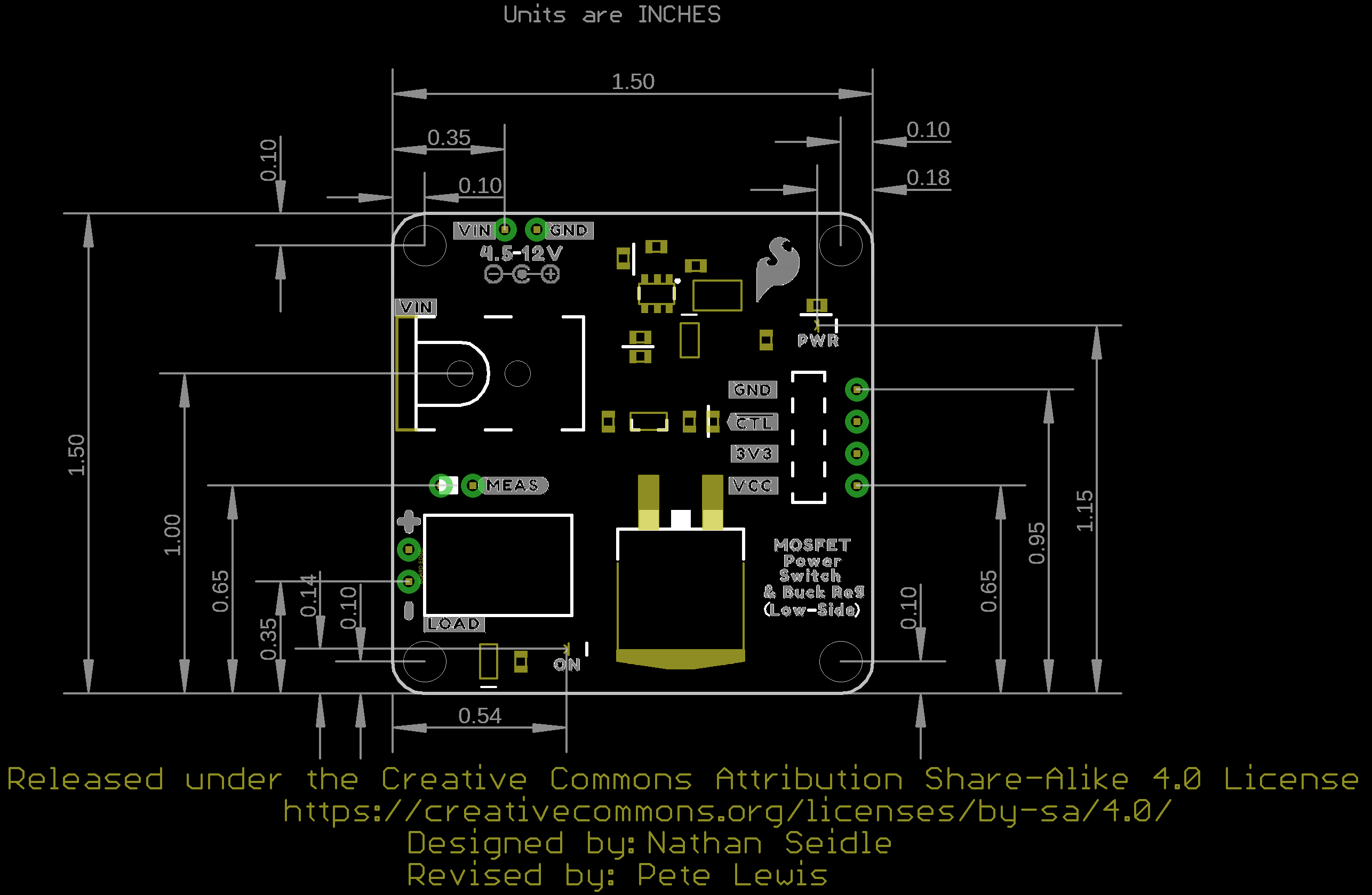
- Dimensions: 1.50" x 1.50" (38.1mm x 38.1mm)
- Weight: 9.9g
Jargon buster
Plain-language definitions for the technical terms used above.
- GND
- GND is the ground or reference connection (0 V) for a circuit. When connecting two devices together, their grounds must be joined so both agree on what counts as a low or high signal.
- Headers
- Rows of connector contacts on a fixed pitch (commonly 2.54 mm) used to link a board to a breadboard, jumper wires, or another board. They come as male pin headers and female socket headers; when a module ships with pre-soldered headers it can be used straight away, whereas bare pads require soldering the pins yourself.
- LED
- A light-emitting diode (LED) is a small electronic component that emits light when current flows through it in the correct direction. Because it only conducts one way, its polarity matters, and a through-hole LED must be soldered the correct way around to light up.
- microcontroller
- A microcontroller is a small computer on a single chip that runs a stored program and controls connected inputs and outputs such as buttons, sensors, displays and communication interfaces. In a device built around one, it is the part that executes the code and coordinates the device's behaviour.
- PCB
- A printed circuit board (PCB) is a board, usually rigid, with etched copper tracks that connect electronic components together without loose wiring. Components are mounted on the board and signals route between them through the copper layout.
- PTH
- Plated through-hole means the pin holes are metal-lined so solder connects the pad on both sides of the board. It is useful for connectors and headers that need a strong mechanical and electrical connection.
- VCC
- VCC is the positive power-supply connection on a chip or module. Connecting it to the correct supply voltage is needed for the part to power on and helps avoid damaging the electronics.
Find this product in
Brands
Power & Batteries
MOSFET Power Switch and Buck Regulator Schematic
Schematic · 138.4 KB · Click any page to view full size
LMR14203 Datasheet
Datasheet · 505.0 KB · Click any page to view full size
PSMN7R0-100BS Datasheet
Datasheet · 971.0 KB · Click any page to view full size
Supplier page — sparkfun.com
Supplier Description · 841.4 KB · Click any page to view full size
Resources & Downloads
Guides, code examples, and more
Source Code
Open-source libraries, firmware & example projects for this product
This repo houses all of the SFE Fritzing parts for use in diagrams in tutorials. If you create a new part in Fritzing that correlates to an SFE part, please add it here so others may use it and to avoid duplication.
71b17bb
about 2 years ago
· 339 commits
- kits Include SparkFun Inventor's Kit V4.1 almost 3 years ago
- parts Add Horizontal and Vertical Qwiic Connector and Cable to Breadboard Half (Top View) over 6 years ago
- products Update 13664_sfe_samd21_mini_breakout.fzpz about 2 years ago
- templates Renamed over 11 years ago
- License.md Create License.md over 7 years ago
- README.md Update README.md over 7 years ago
- SparkFun Plus.fzbz First Pass on SparkFun Plus bin file almost 7 years ago
- SparkFun_Plus.png Adding png for fzbz use almost 7 years ago
Tutorial and hardware files for a digital switch capable of switching DC loads up to 12V. Includes 3.3V Buck Regulator, N-channel MOSFET low-side switch circuit, and flyback diode on the load side.
667aa8e
4 months ago
· 38 commits
- .github Update mkdocs.yml 4 months ago
- docs Initial GitHub Pages Tutorial to Main over 2 years ago
- Firmware Initial GitHub Pages Tutorial to Main over 2 years ago
- Hardware updated Q1 and R11 over 2 years ago
- overrides Initial GitHub Pages Tutorial to Main over 2 years ago
- .gitignore add 4-pin female header almost 3 years ago
- LICENSE.md Create LICENSE.md almost 3 years ago
- mkdocs.yml Update mkdocs.yml 4 months ago
- README.md Update README.md over 2 years ago