SparkFun
SparkFun Micro Temperature Sensor - STTS22H (Qwiic)
The SparkFun STTS22H Micro Temperature Sensor is a Qwiic-enabled breakout board based on the ultralow-power, high-accuracy, digital temperature sensor STTS22...
Get notified when back in stock
The SparkFun STTS22H Micro Temperature Sensor is a Qwiic-enabled breakout board based on the ultralow-power, high-accuracy, digital temperature sensor STTS22H from ST Microelectronics and housed in our Qwiic Micro form factor. Thanks to its factory calibration the STTS22H offers high-end accuracy performance over the entire operating temperature range, reaching as low as ±0.5°C without requiring any further calibration at the application level.
The sensor operating mode is user-configurable and allows selecting between different ODRs (down to 1Hz) or the one-shot mode for battery saving. In one-shot mode, the sensor current consumption falls to 1.75µA. Peripheral addresses are also user-configurable and allow up to four different addresses to be specified by manipulating the jumpers on the back of the breakout. In addition, an interrupt pin is available to signal the application whenever the user-selectable high or low threshold has been exceeded.
Hook-up is a breeze as the breakout board uses the Qwiic Connect System. The breakout board has built-in 2.2kΩ pullup resistors for I2C communications. If you’re hooking up multiple I2C devices on the same bus, you may want to disable these resistors.
The SparkFun Qwiic Connect System is an ecosystem of I2C sensors, actuators, shields and cables that make prototyping faster and less prone to error. All Qwiic-enabled boards use a common 1mm pitch, 4-pin JST connector. This reduces the amount of required PCB space, and polarized connections mean you can’t hook it up wrong.
Features:
- Uses I2C interface (Qwiic-enabled)
- Two selectable addresses
- 0x3C (default),0x38
- Operating temperature: -40°C to +125°C
- Temperature accuracy (max): ± 0.5 °C (-10 °C to +60 °C)
- Operating voltage: 1.5V to 3.6V
- Typically 3.3V if using the Qwiic cable
- Ultralow current: 1.75 µA in one-shot mode
- Programmable thresholds with interrupt pin
- Programmable operating modes
- Freerun, one-shot, and Low-ODR
- NIST traceability
- Qwiic Micro Form Factor
Documents:
- Schematic
- Eagle Files
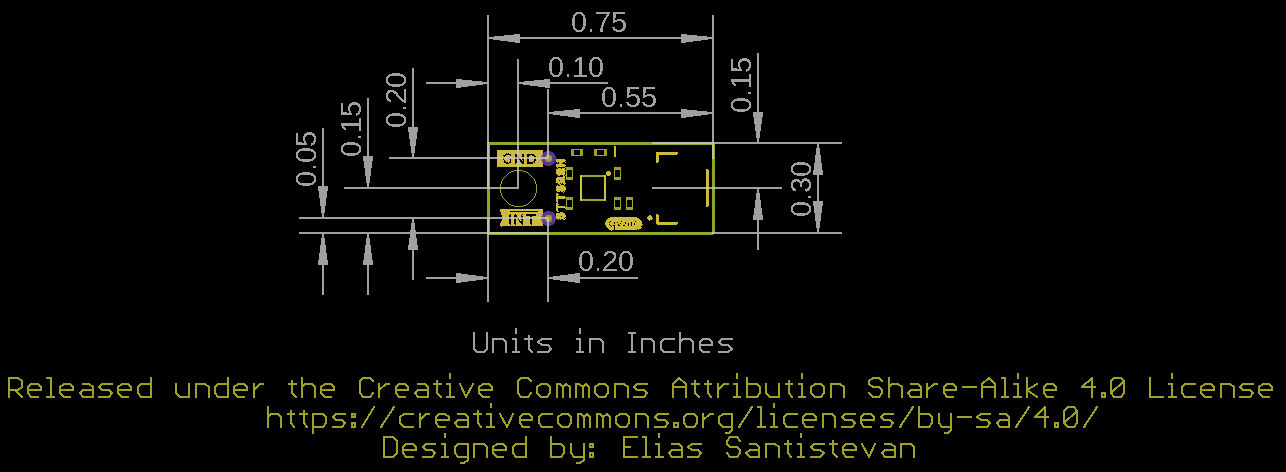
- Board Dimensions
- Hookup Guide
- Datasheet (STTS22H)
- Qwiic Info Page
- STTS22H Arduino Library
- GitHub Hardware Repo
Videos
Jargon buster
Plain-language definitions for the technical terms used above.
- breakout
- A breakout board carries a small or fine-pitched component and brings its connections out to standard, breadboard- and header-friendly pins. Describing a part as a breakout means it can be wired into a project without soldering directly to the component's tiny contacts.
- I2C
- I2C is a two-wire communication bus used by many sensors and small modules. It matters because several I2C devices can share the same two wires, but each device needs a compatible address and your controller must support I2C.
- NIST traceability
- A way of linking a measurement back to standards maintained by the US National Institute of Standards and Technology. For temperature sensing, it matters when you need documented confidence that readings can be compared to recognised measurement standards.
- ODR
- ODR means output data rate: how often the sensor produces a new measurement. A higher ODR can capture faster motion or vibration, but it usually uses more power and creates more data for the microcontroller to handle.
- PCB
- A printed circuit board (PCB) is a board, usually rigid, with etched copper tracks that connect electronic components together without loose wiring. Components are mounted on the board and signals route between them through the copper layout.
- Qwiic
- Qwiic is a plug-in connector system for I2C devices that uses small 4-pin cables, so you can connect compatible sensors without soldering. It matters because your controller or adapter also needs Qwiic, or you will need a cable or breakout to wire it up.
Find this product in
SparkFun Micro Temperature Sensor STTS22H Schematic
Schematic · 89.7 KB · Click any page to view full size
STTS22H Datasheet
Datasheet · 1.6 MB · Click any page to view full size
Supplier page — sparkfun.com
Supplier Description · 584.2 KB · Click any page to view full size
SparkFun Temperature Sensor STTS22H Schematic
Schematic · 91.0 KB · Click any page to view full size
Resources & Downloads
Guides, code examples, and more
Source Code
Open-source libraries, firmware & example projects for this product
A Qwiic enabled breakout boards based on the ultralow-power, high-accuracy, digital temperature sensor STTS22H from ST Microelectronics.
9d0e0f4
over 3 years ago
· 38 commits
- Documentation Initial Commit almost 4 years ago
- Hardware Adds 56k to R7 almost 4 years ago
- Production Renames panel to to include version number almost 4 years ago
- License.md Create License.md over 3 years ago
- README.md Update README.md over 3 years ago
- STTS22H.lbr Updates temp sensor footprint to have reduced pasted on center pad almost 4 years ago
9d66d9a
almost 3 years ago
· 24 commits
- .github Create add_issue_to_project.yml almost 3 years ago
- Documentation Adds comments describing functions almost 4 years ago
- examples Fixes typos in comments almost 4 years ago
- src Renames some variables, fixes wrong variable being converted over 3 years ago
- library.properties Update library.properties over 3 years ago
- LICENSE.md Create LICENSE.md over 3 years ago
- README.md Update README.md over 3 years ago