SparkFun
SparkFun CO₂ Humidity and Temperature Sensor - SCD41 (Qwiic)
This SparkFun CO2 Humidity and Temperature Sensor features the next-generation SCD41 photoacoustic CO2 sensor for high-accuracy environmental readings. The S...
Get notified when back in stock
- I2C Interface (Qwiic-enabled)
- I2C Address: 0x62
- 2x Qwiic Connectors
- Supply Voltage Range: 2.4-5.5V (3.3V Typ.)
- Low Current Consumption:
- Normal Mode:
- Max: 205mA@3.3V
- Typ: 18mA@3.3V
- Low Power Mode:
- Typ: 3.5mA@3.3V
- Single-Shot:
- 0.5mA@3.3V
- Normal Mode:
- Photoacoustic Measurement System
- Sensirion's PASens Technology
- Integrated Temperature and Humidity Sensor
- Sensirion's CMOSens Technology
- CO2 Output Range: 0-40,000ppm
- CO2 Measurement Accuracy: ±(40ppm + 5% of reading)
- Conditions: 400-5,000ppm
- Humidity Range: 0-100%RH
- Humidity Accuracy: ±9%RH (Full Range)
- Temperature Range: -10°C-60°C
- Temperature Accuracy: ±1.5 (Full Range)
- Schematic
- Eagle Files
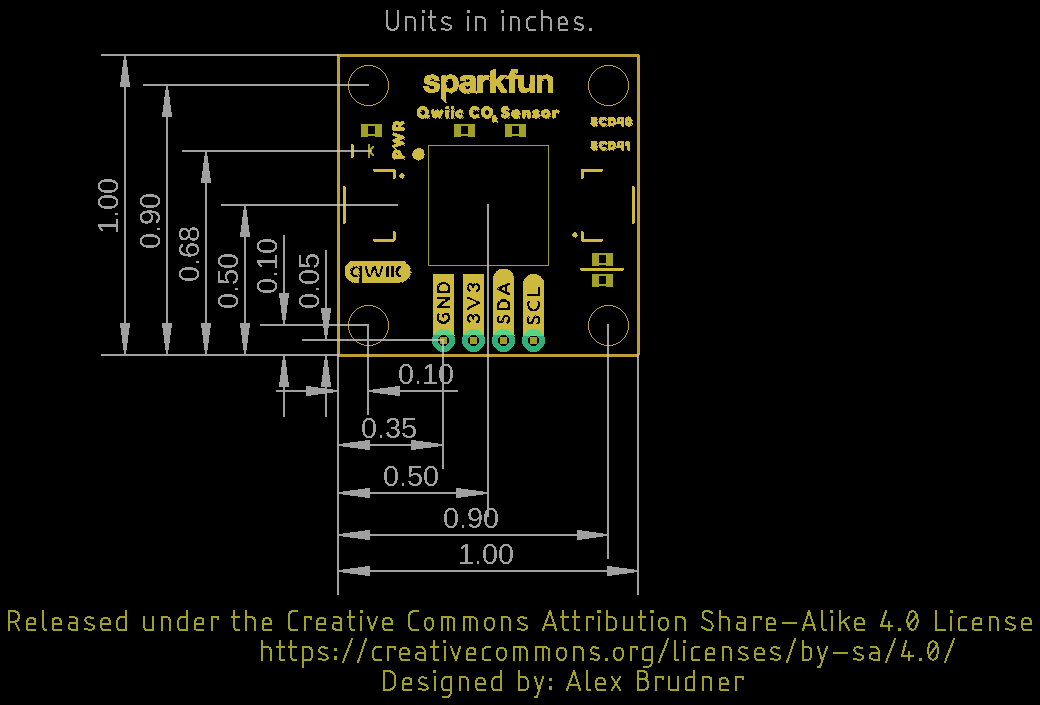
- Board Dimensions
- Hookup Guide
- Datasheet (SCD4X)
- Qwiic Information Page
- SCD4X Arduino Library
- Github Hardware Repo
Jargon buster
Plain-language definitions for the technical terms used above.
- Automatic Self-Calibration
- Automatic Self-Calibration is a built-in routine that adjusts the sensor over time to reduce drift in its readings. It matters for long-running indoor monitors because it can help keep measurements stable without frequent manual calibration.
- CMOSens
- CMOSens is Sensirion’s integrated sensor technology that combines sensing elements and electronics in one package. It matters because it affects how the sensor measures temperature and humidity and how it is supported by the manufacturer’s libraries and datasheets.
- I2C
- I2C is a two-wire communication bus used by many sensors and small modules. It matters because several I2C devices can share the same two wires, but each device needs a compatible address and your controller must support I2C.
- I2C address
- An I2C address is the number a device uses so a microcontroller can tell it apart from other devices on the same I2C bus. It matters because two devices with the same fixed address may conflict if used together.
- PASens
- PASens is Sensirion’s name for its photoacoustic sensing technology used in some CO2 sensors. Knowing this helps explain why the sensor uses light and a microphone internally rather than a simple chemical gas sensor.
- PCB
- A printed circuit board (PCB) is a board, usually rigid, with etched copper tracks that connect electronic components together without loose wiring. Components are mounted on the board and signals route between them through the copper layout.
- photoacoustic measurement
- Photoacoustic measurement detects gas by shining light into a sample and listening for tiny pressure waves created when the gas absorbs that light. In a CO2 sensor, this matters because it is the method used to estimate carbon dioxide concentration.
- ppm
- ppm means parts per million, a common way to express very small gas concentrations in air. For CO₂ sensors, the ppm range tells you what levels the sensor can measure, such as normal indoor air through to poorly ventilated spaces.
- Qwiic
- Qwiic is a plug-in connector system for I2C devices that uses small 4-pin cables, so you can connect compatible sensors without soldering. It matters because your controller or adapter also needs Qwiic, or you will need a cable or breakout to wire it up.
- SCD41
- A Sensirion sensor module that measures carbon dioxide, temperature, and humidity. The part number matters because library support, I2C address, accuracy, power use, and measurement range are specific to this sensor.
Find this product in
Brands
SparkFun Qwiic CO₂ Sensor SCD41 Schematic
Schematic · 90.8 KB · Click any page to view full size
Sensirion SCD4x Datasheet
Datasheet · 937.6 KB · Click any page to view full size
Supplier page — sparkfun.com
Supplier Description · 748.3 KB · Click any page to view full size
Resources & Downloads
Guides, code examples, and more
Source Code
Open-source libraries, firmware & example projects for this product
An Arduino library for the Sensirion SCD4x (SCD40 and SCD41) family of CO2 sensors
0721971
about 3 years ago
· 29 commits
- .github Create add_issue_to_project.yml about 3 years ago
- documents Initial commit - work in progress over 5 years ago
- examples Fix sensor determination. over 3 years ago
- src Fix sensor determination. over 3 years ago
- keywords.txt Fix sensor determination. over 3 years ago
- library.properties Fix sensor determination. over 3 years ago
- LICENSE.md Initial commit - work in progress over 5 years ago
- README.md Update README.md over 3 years ago
This repository implements a Python package for the SparkFun Qwiic SCD4X.
aedadef
over 1 year ago
· 14 commits
- .github Update doxygen deploy branch to master over 1 year ago
- docs Autogenerated. Convert PyPi packaging and add Readme Updates over 1 year ago
- examples Autogenerated: Fix example bullets/markdown links over 1 year ago
- .readthedocs.yml Initial commit almost 2 years ago
- co2_sensor_testing.txt Autogenerated: Convert comments to doxygen and add doxygen configs over 1 year ago
- DESCRIPTION.rst Autogenerated: Bump version number to 2.0.0 over 1 year ago
- DOCUMENTATION.md Initial commit almost 2 years ago
- LICENSE Initial commit almost 2 years ago
- package.json Autogenerated: Bump version number to 2.0.0 over 1 year ago
- pyproject.toml Autogenerated: Bump version number to 2.0.0 over 1 year ago
- qwiic_scd4x.py Autogenerated: Convert comments to doxygen and add doxygen configs over 1 year ago
- README.md Autogenerated: Update supported boards. over 1 year ago
- requirements.txt Autogenerated: Add requirements.txt for circup packaging dependencies over 1 year ago
Qwiic breakout for the Sensirion SCD4x CO2 sensors.
cc7038a
almost 2 years ago
· 17 commits
- .github Update mkdocs.yml over 3 years ago
- docs Adding Video and minor fixes over 3 years ago
- Documentation Added datasheet. over 3 years ago
- Firmware Initial commit over 3 years ago
- Hardware Update from pre-design review notes. over 3 years ago
- overrides Redirect/Header Files over 3 years ago
- Production Update from pre-design review notes. over 3 years ago
- site Adding Video and minor fixes over 3 years ago
- .gitattributes Initial commit over 3 years ago
- .gitignore Initial commit over 3 years ago
- CONTRIBUTING.md Initial commit over 3 years ago
- ISSUE_TEMPLATE.md Initial commit over 3 years ago
- LICENSE.md Initial commit over 3 years ago
- mkdocs.yml Update mkdocs.yml almost 2 years ago
- README.md Update README.md over 3 years ago