

Adafruit
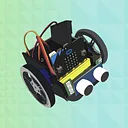
Smart Car Cutebot Robot for micro:bit
·
This fully-assembled and ready-to-rock robot smart car is the nicest we've seen and is incredibly easy to use with a micro:bit and MakeCode. It comes all rea...
Get notified when back in stock
This fully-assembled and ready-to-rock robot smart car is the nicest we've seen and is incredibly easy to use with a micro:bit and MakeCode. It comes all ready to go, no soldering or screw-driver required. Simply plug in your :bit into the top slot and add three AAA batteries to get moving.
The Cutebot is a rear-drive smart car driven by dual high speed motors so it can zip around your floor. It comes with an ultrasonic distance sensor to avoid colliding with walls, two RGB LED headlights and two underlights, two line-tracking light sensors, an active buzzer to make beeps and tones, and various headers for attaching additional servos and sensors.
Note: Does not include micro:bit or AAA batteries. This is just the Cutebot kit by itself!
Features:
- Rear-drive high speed motors featuring strong, metal-geared N20 motors with 300 RPM max speeds and rubber tires.
- Cute with a small round structure, the PCB body is durable, crash-proof and easy to pick up and move around.
- Only batteries and ultrasonic sensor need to be assembled featuring easy installation. No soldering or tools required!
- Slot for ultrasonic distance sensor and I2C port for additional sensor add-ons on front edge
- Headers for additional servos and sensors on back edge.
- Metal caster wheel
- Flexible and fast movement
- Dual line-tracking light sensors
- Infrared sensor can support optional IR remote control
- Multiple rainbow LEDs!
Jargon buster
Plain-language definitions for the technical terms used above.
- Headers
- Rows of connector contacts on a fixed pitch (commonly 2.54 mm) used to link a board to a breadboard, jumper wires, or another board. They come as male pin headers and female socket headers; when a module ships with pre-soldered headers it can be used straight away, whereas bare pads require soldering the pins yourself.
- I2C
- I2C is a two-wire communication bus used by many sensors and small modules. It matters because several I2C devices can share the same two wires, but each device needs a compatible address and your controller must support I2C.
- LED
- A light-emitting diode (LED) is a small electronic component that emits light when current flows through it in the correct direction. Because it only conducts one way, its polarity matters, and a through-hole LED must be soldered the correct way around to light up.
- PCB
- A printed circuit board (PCB) is a board, usually rigid, with etched copper tracks that connect electronic components together without loose wiring. Components are mounted on the board and signals route between them through the copper layout.
- RGB
- Short for red, green and blue, the three primary colours of light that are mixed in varying amounts to make a wide range of colours. In electronics RGB can refer to an LED or pixel that blends these three colours, or to a colour signal or interface that carries separate red, green and blue channels.
Find this product in
STEM & Education
Related Tutorials
Free step-by-step guides
Featured in buying guides
Comparison guides this product appears in

