

Little Bird
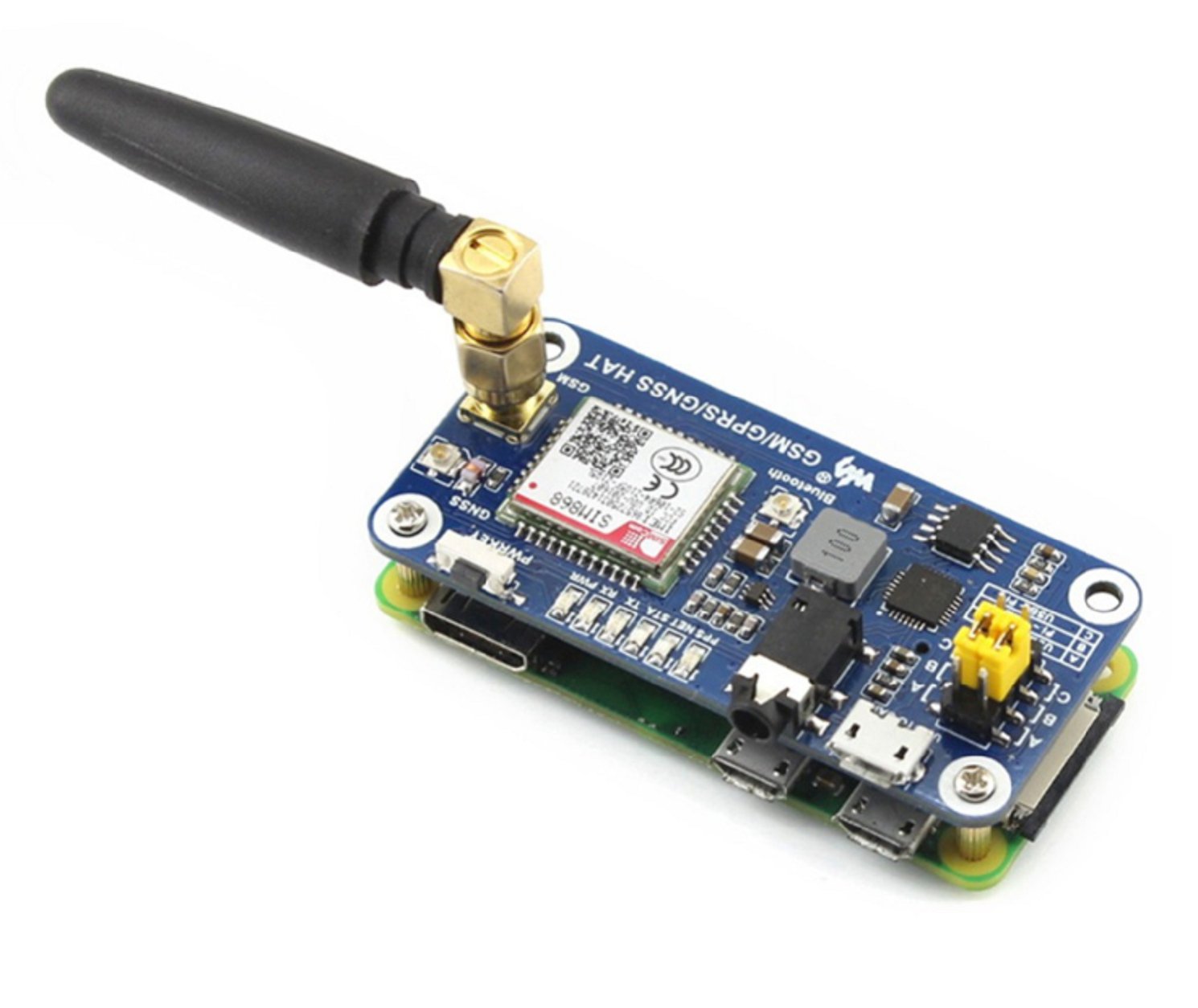
SIM868 GSM GPRS GNSS Bluetooth 3.0 HAT for Raspberry
Raspberry Pi connectivity, compatible with Raspberry Pi 2B/3B/3B+/Zero/Zero WSupports SMS, phone call, GPRS, DTMF, HTTP, FTP, MMS, email, etc.Support GPS, CO...
Get notified when back in stock
Raspberry Pi connectivity, compatible with Raspberry Pi 2B/3B/3B+/Zero/Zero W
Supports SMS, phone call, GPRS, DTMF, HTTP, FTP, MMS, email, etc.
Support GPS, COMPASS, Glonass, LBS base station positioning, omni-positioning
Bluetooth 3.0, supports data transferring through Bluetooth
Onboard USB TO UART converter CP2102 for UART debugging
6x LEDs for indicating the module working status
SIM card slot for 1.8V/3V SIM card
RTC with backup battery holder
Baud rate auto detection (1200bps ~115200bps)
Control via AT commands (3GPP TS 27.007, 27.005, and SIMCOM enhanced AT Commands)
Supports SIM application toolkit: GSM 11.14 Release 99
Comes with development resources and manual (examples for Raspberry Pi/Arduino/STM32)
GSM/GPRS
Band
- GSM 850/EGSM 900/DCS 1800/PCS 1900 MHz
- Quad-band auto search
- Compliant to GSM phase 2/2+
Emitting power
- Class 4 (2W @ GSM 850/EGSM 900 MHz)
- Class 1 (1W @ DCS 1800/PCS 1900 MHz)
GPRS connectivity
- GPRS multi-slot class 12 (default)
- GPRS multi-slot class 1~12 (configurable)
GPRS data feature
- Downlink speed: max 85.6kbps
- Uplink speed: max 85.6kbps
- Coding schemes: CS-1\CS-2\CS-3\CS-4
- Supports PAP (Password Authentication Protocol) for PPP connection
- Supports PBCCH
- Supports USSD
SMS
- Supports: MT/MO/CB/Text/PDU mode
- SMS storage: SIM card
Audio
- Voice encode/decode mode: Half Rate\Full Rate\Enhanced Full Rate\Adaptive muti rate
- Supports echo cancellation
- Supports noise reduction
GNSS
- Receiver type
- 33 tracking channels
- 99 acquisition channels
- GPS L1 C/A code
Sensitivity
- Tracking: -165 dBm
- Cold starts : -148 dBm
Time-To-First-Fix
- Cold starts : 28s (typ.)
- Hot starts : < 1s
- Warm starts: 26s
Accuracy
- Horizontal position : <2.5m CEP
Bluetooth
- Integrates AT commands
- Compliant to Bluetooth specification3.0 + EDR
- Supports SPP, OPP, HFP/HSP, etc.
Misc
- Operating voltage: 5V
- Operating temperature: -40°C ~ 85°C
- Storage temperature: -45°C ~ 90°C
- Dimensions: 30.2mm x 65mm
Package Includes:
- 1 X GSM/GPRS/GNSS HAT
- 1 X GSM Antenna
- 1 X GPS External Antenna (B)
- 1 X Bluetooth Antenna
- 1 X USB type A plug to micro plug cable
- 1 X RPi screws pack (2pcs)
Jargon buster
Plain-language definitions for the technical terms used above.
- baud
- Baud is the signalling rate of a serial connection, often used as the speed setting for UART communication. Matching the baud rate matters because both connected devices must use the same setting for readable data.
- CS
- CS stands for chip select, a control pin used by SPI devices to tell which connected device should listen. It matters when you connect more than one SPI module to the same microcontroller, because each device usually needs its own CS pin.
- GLONASS
- Russia’s satellite navigation system. A receiver that can also use GLONASS has more satellites to choose from, which can improve positioning reliability when the sky view is partly blocked.
- GNSS
- GNSS stands for Global Navigation Satellite System, an umbrella term for satellite positioning networks such as GPS, GLONASS, Galileo and BeiDou. Receivers use these satellites to determine position, and high-precision units can output a steady stream of serial position data.
- GPS
- The US satellite navigation system used by GNSS receivers to calculate position and time. Support for GPS is important because it is widely available and often used together with other constellations for more reliable positioning.
- RTC
- A Real-Time Clock keeps track of time even when the main processor is asleep or powered down, usually with a small backup battery. It matters for data logging and tracking projects that need accurate timestamps.
- STM32
- STM32 is a family of microcontroller chips commonly used in embedded electronics. Knowing a product uses an STM32 can help when looking at firmware updates, pin connections, or low-level serial control options.
- UART
- UART is a simple asynchronous serial interface that sends data over separate transmit and receive wires, usually labelled TX and RX, with both ends set to the same baud rate. It is a common way for microcontrollers and other serial devices to exchange data.
Find this product in
Raspberry Pi

