

Adafruit
PowerBoost 1000 Basic - 5V USB Boost @ 1000mA from 1.8V+
·
PowerBoost is the perfect power supply for your power-hungry portable project! This little DC/DC boost converter module can run from 1.8V batteries or hig...
Get notified when back in stock
PowerBoost is the perfect power supply for your power-hungry portable project! This little DC/DC boost converter module can run from 1.8V batteries or higher, and convert that voltage to 5.2V DC for running your 5V projects. With a beefy 4A DC/DC converter, it can give you 1A+ from as low as 2V.
Like our popular 5V 1A USB wall adapter, we tweaked the output to be 5.2V instead of a straight-up 5.0V so that there's a little bit of 'headroom' long cables, high draw, the addition of a diode on the output if you wish, etc. The 5.2V is safe for all 5V-powered electronics like Arduino, Raspberry Pi, or Beagle Bone while preventing icky brown-outs during high current draw because of USB cable resistance.
The PowerBoost 1000 has at the heart a TPS61030 boost converter from TI. This boost converter chip has some really nice extras such as low battery detection, 4A internal switch, synchronous conversion, excellent efficiency, and 700KHz high-frequency operation. Check out these specs!
- Synchronous operation means you can disconnect the output completely by connecting the ENable pin to ground. This will completely turn off the output
- 4A internal switch means you can get 1000mA+ from as low as 1.8V, 1500mA+ from 2 NiMH or Alkaline batteries, and at least 2000mA from a 3.7V LiPoly/LiIon battery or 3 NiMH/Alkalines. Just make sure your batteries can actually supply the required 2-4A, OK?
- Low battery indicator LED lights up red when the voltage dips below 3.2V, optimized for the most common usage of LiPo/LiIon battery usage
- On-board 1000mA charge-rate 'Apple/iOS' data resistors. Solder in the included USB connector and you can plug in any iPhone or iPod for a speedy 1000mA charge rate. Works with iPads, both mini and 'classic' type.
- Full breakout for battery in, control pins and power out
- 90%+ operating efficiency in most cases (see datasheet for efficiency graphs), and low quiescent current: 5mA when enabled and power LED is on, 20uA when disabled (power and low batt LED are off)
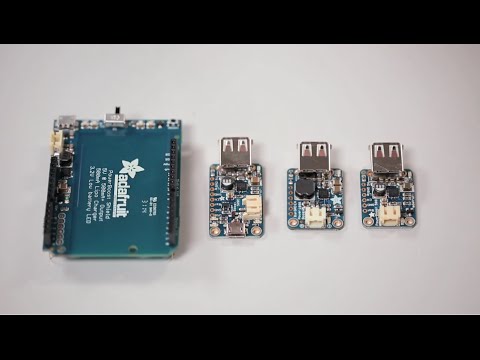
Great for powering your robot, Arduino project, single-board-computer such as Raspberry Pi or BeagleBone! Each order comes with one fully assembled and tested PCB, a loose 2-PH JST jack, a 2-pin Terminal block and a loose USB A jack.
If you are powering your project from USB, solder the USB A jack in (a 3-minute soldering task). Then choose either JST for input (JST is often used for our LiIon batteries, but the connector is only rated for 2A) or a terminal block.
The 1000 version comes with a 2-pin terminal block so you can solder it to the output spot where the USB jack would go. Or don't solder any connectors in for a more compact power pack and go with 22AWG wires soldered directly in.
Note: The terminal blocks included with your product may be blue or black.
Jargon buster
Plain-language definitions for the technical terms used above.
- boost converter
- A boost converter is a switching power circuit that raises a lower input voltage to a higher output voltage. It is used when a device needs more voltage than its power source provides, for example running a 5 V sensor from a 3.3 V supply.
- breakout
- A breakout board carries a small or fine-pitched component and brings its connections out to standard, breadboard- and header-friendly pins. Describing a part as a breakout means it can be wired into a project without soldering directly to the component's tiny contacts.
- DC
- DC means direct current, where electricity flows in one constant direction, as supplied by batteries, USB ports and many plug-pack power supplies. When a product specifies DC, it runs from a DC supply rather than mains AC, so you need to provide the correct voltage and polarity.
- LED
- A light-emitting diode (LED) is a small electronic component that emits light when current flows through it in the correct direction. Because it only conducts one way, its polarity matters, and a through-hole LED must be soldered the correct way around to light up.
- LiPo
- A LiPo (lithium polymer) battery is a rechargeable lithium battery widely used in portable projects because it is light and compact. LiPo cells need correct charging circuitry and careful handling to stay safe, so equipment that supports LiPo generally includes charging or protection hardware suited to that battery type.
- PCB
- A printed circuit board (PCB) is a board, usually rigid, with etched copper tracks that connect electronic components together without loose wiring. Components are mounted on the board and signals route between them through the copper layout.
- Terminal block
- A terminal block is a connector that joins wires together in a neat, removable, or serviceable way, usually clamping each wire under a screw or spring instead of soldering. It makes it easier to connect, change, or service wiring without permanent joints.
Find this product in
Brands
Power & Batteries

