Adafruit
PiTFT - Assembled 480x320 3.5 TFT+Touchscreen for Raspberry Pi
·
Is this not the cutest, little display for the Raspberry Pi? It features a 3.5" display with 480x320 16-bit color pixels and a resistive touch overlay so ...
Get notified when back in stock
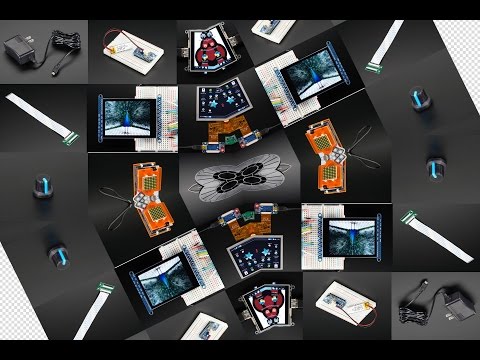
Is this not the cutest, little display for the Raspberry Pi? It features a 3.5" display with 480x320 16-bit color pixels and a resistive touch overlay so is slightly larger than our popular original. The plate uses the high speed SPI interface on the Pi and can use the mini display as a console, X window port, displaying images or video etc. Best of all it plugs right in on top!
This PiTFT 3.5" is designed to fit nicely onto the Pi 1 Model A or B but also works OK with the Raspberry Pi Zero, 3, 2 Model B or Pi Model A+ or B+ as long as you don't mind the PCB overhangs the USB ports by 5mm. If you'd like a version that is designed for the Pi Zero / 3 / 2 / A+ / B+ check out the PiTFT Plus 3.5"
Uses the hardware SPI pins (SCK, MOSI, MISO, CE0, CE1) as well as GPIO #25 and #24. GPIO #18 can be used to PWM dim the backlight if you like. All other GPIO are unused. There's a 2x13 header on the bottom, you can connect a standard Pi GPIO cable to it to use any of the other pins ask you like.
Best of all, it comes fully assembled and ready to plug into your Pi! You can use this as a display for running the X interface, or pygame. You can also have an HDMI display seperately connected. There's four mounting ears that can be used to attach the display & Pi to a bezel, or snap them off with pliers (they're perforated) for a slick exactly-the-same-size-as-a-Pi look.
We've created a custom kernel package based of off Notro's awesome framebuffer work, so you can install it over your existing Raspbian (or derivative) images in just a few commands. Our tutorial shows you how to install the software, as well as calibrate the touchscreen, display images such as from your PiCam and more!
Jargon buster
Plain-language definitions for the technical terms used above.
- GPIO
- General-purpose input/output pins are microcontroller pins you can set in software to read signals, switch devices on and off, or connect to peripherals. The number of GPIO pins matters because it limits how many buttons, LEDs, sensors, and other parts you can wire directly to the board.
- HDMI
- HDMI is a common digital video and audio connection used by computers, media players, and many displays. If a display kit has HDMI input, it is usually much easier to test with a single-board computer because it can act like a normal monitor.
- PCB
- A printed circuit board (PCB) is a board, usually rigid, with etched copper tracks that connect electronic components together without loose wiring. Components are mounted on the board and signals route between them through the copper layout.
- PWM
- Pulse Width Modulation is a way for a digital pin to simulate variable output power by switching on and off very quickly. It matters for controlling things like LED brightness, motor speed, or servo-style signals from a microcontroller pin.
- SPI
- A fast serial communication bus often used for displays, memory cards, and sensors. It matters because SPI devices need specific pins for clock and data, plus a separate chip-select line for each device.
Find this product in
Brands
Displays & Screens
adafruit pitft 3 dot 5 touch screen for raspberry pi
Document · 5.2 MB · Click any page to view full size
Resources & Downloads
Guides, code examples, and more
Related Tutorials
Free step-by-step guides