

DFRobot
FireBeetle ESP8266 IOT Microcontroller (Supports Wi-Fi)
DFRobot FireBeetle is a series of low-power-consumption development hardware designed for Internet of Things (IoT). Firebeetle ESP8266 is a development board...
Get notified when back in stock
Compatible with Arduino programming enables Firebeetle ESP8266 to lower the barrier of programming. Operator can implement Arduino programming codes directly onto ESP8266 to reduce the difficulty of operating and increase the stability of board.
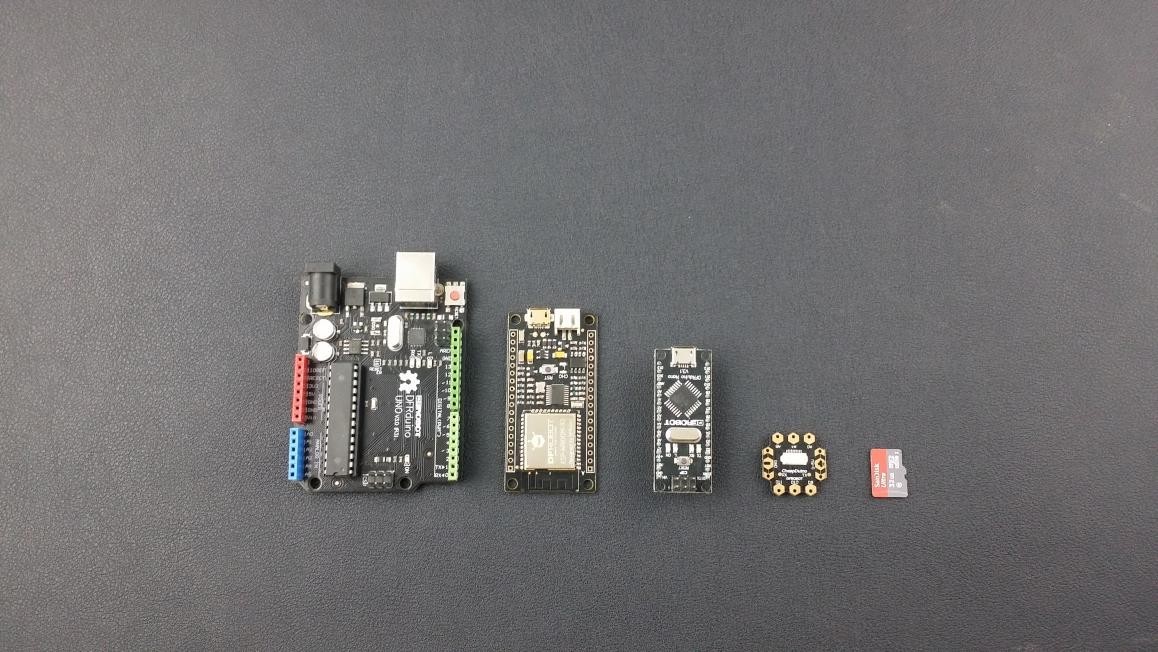
In programming stage, Firebeetle Board-ESP8266 supports RTOS SDK in Linux, arduino IDE and Micropython.

FEATURES
- Compatible with FireBeetle series
- Compatible with Arduino programing
- Built-in 32-bit Tensilica L106 MCU and 10-bit ADC
- Support RTOS SDK in Linux, Arduino IDE and Micropython.
- Support IEEE802.11 b/g/n WiFi (2.4 GHz~2.5 GHz)
- Support TCP / IP
- Support Lithium Battery (The Maximum charge current: 500mA)
- Support Low Power Consumption
- Support OTA Updating
- Support STA/AP/STA+AP
SPECIFICATION
- Operating Temperature: -40℃~+85℃
- Operating Voltage: 3.3V
- Input Voltage (limits): 3.3~5V (Lithium Battery:3.7V & USB:5V)
- Microcontroller: Tensilica L106 (32-bit MCU)
- Clock Speed: 80MHz (Maximum: 160MHz)
- SRAM:50KB
- External Flash Memory: 16MB
- DC Current in the Low-Power-Consumption: 46uA
- Average Operating Current: 80mA
- Maximum Discharging Current: 600mA (LDO-3.3 Output)
- Maximum Charging Current: 500mA
- Digital Pin x10
- Analog Pin x1
- SPI interface x1
- I2C interface x1
- IR interface x1
- I2S interface x1
- Interface: XH2.54mm Pin (No soldering default)
- In Combination of Wi-Fi MAC/ BB/RF/PA/LNA
- WiFi: IEEE802.11 b/g/n (2.4 GHz~2.5 GHz), not support 5GHz WiFi
- Dimension: 58 × 29(mm)
- Operating Temperature: -10℃~+55℃
- Mounting Hole Dimension: 53 x 24(mm)
- Weight: 24g
DOCUMENTS
Jargon buster
Plain-language definitions for the technical terms used above.
- ADC
- An analogue-to-digital converter reads a changing voltage and turns it into a number the microcontroller can use. It matters when connecting analogue sensors such as light, sound, or variable-resistor sensors.
- DC
- DC means direct current, where electricity flows in one constant direction, as supplied by batteries, USB ports and many plug-pack power supplies. When a product specifies DC, it runs from a DC supply rather than mains AC, so you need to provide the correct voltage and polarity.
- Flash memory
- Flash memory is non-volatile memory that retains stored data even when power is removed, and can be erased and rewritten in blocks. It lets data such as firmware, settings or saved records persist across power cycles.
- I2C
- I2C is a two-wire communication bus used by many sensors and small modules. It matters because several I2C devices can share the same two wires, but each device needs a compatible address and your controller must support I2C.
- I2S
- I2S is a digital audio interface used to send sound data between chips, such as from a microcontroller to an audio amplifier or DAC. It matters if your project needs cleaner digital audio output than a basic buzzer or PWM signal can provide.
- IDE
- Short for Integrated Development Environment, a program used to write, run and manage code. It matters because some learners prefer a traditional coding workspace instead of a guided notebook-style lesson.
- IoT
- Short for Internet of Things, meaning physical devices that connect to networks or the internet to send data or be controlled remotely. It matters if you want projects such as connected sensors, remote controls or classroom data-logging activities.
- microcontroller
- A microcontroller is a small computer on a single chip that runs a stored program and controls connected inputs and outputs such as buttons, sensors, displays and communication interfaces. In a device built around one, it is the part that executes the code and coordinates the device's behaviour.
- MicroPython
- A version of the Python programming language made to run on microcontrollers. It matters because it lets beginners write readable code to control LEDs, sensors, motors and displays without needing to start with lower-level languages.
- OTA
- OTA means over-the-air updating, where a device's firmware is updated wirelessly rather than through a programming cable. This lets firmware be updated or maintained after a device is installed without a physical connection.
- PWM
- Pulse Width Modulation is a way for a digital pin to simulate variable output power by switching on and off very quickly. It matters for controlling things like LED brightness, motor speed, or servo-style signals from a microcontroller pin.
- RF
- RF means radio frequency, referring to signals used for wireless communication and other high-frequency electronics. A low-noise, stable power supply is important for RF circuits because power noise can affect signal quality and measurements.
- SPI
- A fast serial communication bus often used for displays, memory cards, and sensors. It matters because SPI devices need specific pins for clock and data, plus a separate chip-select line for each device.
- SRAM
- Fast temporary memory used by a processor while a program is running. More SRAM helps with projects that handle larger data buffers, networking, displays, or more complex code.
- UART
- UART is a simple asynchronous serial interface that sends data over separate transmit and receive wires, usually labelled TX and RX, with both ends set to the same baud rate. It is a common way for microcontrollers and other serial devices to exchange data.
Find this product in
Connectivity
Beginner Kit for Arduino Tutorial
User Guide · 6.8 MB · Click any page to view full size
DFR0489 esp8266 iot development board dimension V1.0
Mechanical Drawings · 179.5 KB · Click any page to view full size
DFR0489 esp8266 iot development board datasheet V1.0
Datasheet · 1.2 MB · Click any page to view full size
DFR0489 esp8266 iot development board ce V1.0
Pinout · 875.7 KB · Click any page to view full size
DFR0489 esp8266 iot development board rohs V1.0
Pinout · 452.8 KB · Click any page to view full size
DFR0489 esp8266 iot development board doc V1.0
Pinout · 98.9 KB · Click any page to view full size
Resources & Downloads
Guides, code examples, and more

