

Works great with ESPhome and Home Assistant
Works great with ESPhome and Home Assistant. No issues at all out of the box.
Adam Perfrement
/products/{handle}.md)
and JSON
(/products.json, /products/{handle}.json).
Due to the public holiday, customer service is closed until 10 am October 6th.
DFRobot
DFRobot FireBeetle series is the low-power consumption micro-controller intentionally designed for Internet of Things (IoT) projects. FireBeetle Board - E...
DFRobot FireBeetle series is the low-power consumption micro-controller intentionally designed for Internet of Things (IoT) projects. FireBeetle Board - ESP32 integrates a Dual-Core ESP-WROOM-32 module, which supports MCU and Wi-Fi &Bluetooth dual-mode communication. The electric current is just 10µA in the deep-sleep mode. The main controller supports two power supply methods: USB and 3.7V external lithium battery. And both USB and external DC can charge the Lipo battery directly.
 FireBeetle Board-ESP32 has made a special hardware design for Arduino IDE. You can make a download without switching booth-mode manually. It supports Arduino, IDF (linux), micropython etc. Moreover, FireBeetle made a pin mapping for Arduino IDE. It can be configured with Dx transport, compatible with UNO and reduce the entry barrier. The small size and high performance makes FireBeetle become idea solution for IOT low power consumption projects.
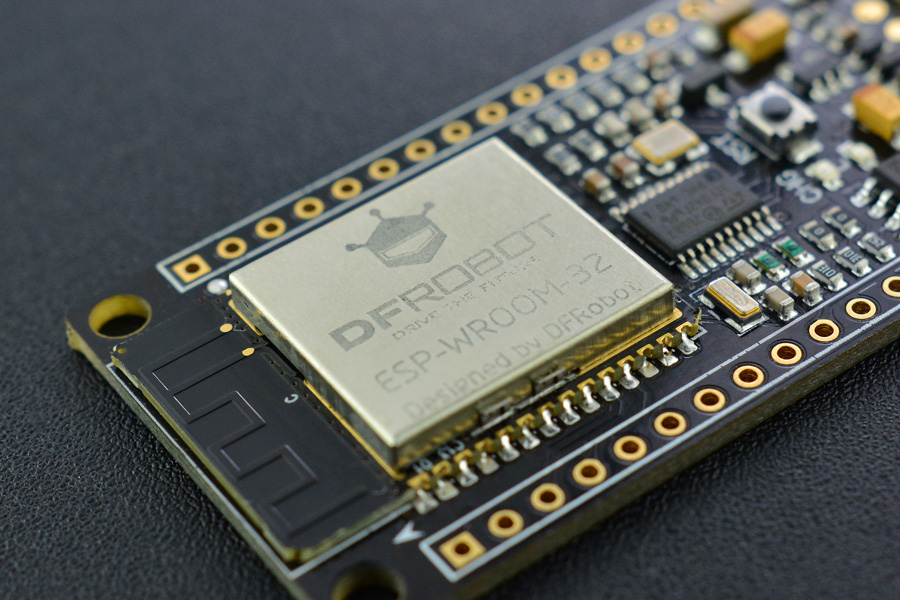 Please kindly note that developers are the most common users of FireBeetle Board-ESP32 and not all of the peripherals have examples for reference, and there are still some bugs being found and fixed. For Arduino IDE, all GPIO function, I2C/SPI communication has been working. But the other functions are still under development. We recommend this board for experienced engineer.
Plain-language definitions for the technical terms used above.
Find this product in
Supplier Description · 777.4 KB · Click any page to view full size
Document · 640.1 KB · Click any page to view full size
Compliance · 505.0 KB · Click any page to view full size
Schematic · 3.4 MB · Click any page to view full size
Datasheet · 1.1 MB · Click any page to view full size
Pinout · 98.9 KB · Click any page to view full size
Guides, code examples, and more

Hi, I'm Maddy. My team and I are ready to help with your order or any questions.
