SparkFun
Arduino Portenta C33
The Arduino Portenta C33 is a cost-effective industrial-grade module built around the Renesas R7FA6M5BH2CBG Arm Cortex-M33 microcontroller running at up to 2...
Get notified when back in stock
The Arduino Portenta C33 is a cost-effective industrial-grade module built around the Renesas R7FA6M5BH2CBG Arm Cortex-M33 microcontroller running at up to 200 MHz. It supports MicroPython and Arduino sketches, with onboard Wi-Fi, Bluetooth Low Energy, and 100 Mbps Ethernet for connected applications.
Security is handled by an NXP SE050C2 secure element at the hardware level, and the board supports over-the-air firmware updates via Arduino IoT Cloud or third-party services. The Portenta form factor with castellated pins makes it suitable for both prototyping and automated assembly lines.
Key Features
- Arm Cortex-M33 @ 200 MHz – Renesas R7FA6M5BH2CBG with Arm TrustZone and Secure Crypto Engine 9
- Wi-Fi + Bluetooth LE – Onboard wireless connectivity
- 100 Mbps Ethernet – Onboard PHY for wired networking
- Hardware Security – NXP SE050C2 secure element
- OTA Updates – Over-the-air firmware via Arduino IoT Cloud
- Castellated Pins – Compatible with Portenta and MKR form factors
- USB-C – High-speed USB connectivity
Specifications
- MCU – Renesas R7FA6M5BH2CBG (Arm Cortex-M33, up to 200 MHz)
- SRAM – 512 KB onboard
- Flash – 2 MB onboard + 16 MB external QSPI
- Connectivity – Wi-Fi, Bluetooth LE, 100 Mbps Ethernet
- Security – NXP SE050C2 secure element, Arm TrustZone
- Interfaces – CAN, SD card, ADC, GPIO, SPI, I²S, I²C, JTAG/SWD
- USB – USB-C (High Speed)
- Operating Temperature – −40°C to +85°C
- Dimensions – 66.04 × 25.40 mm
Ideal For
- IoT gateways and connected devices
- Remote control and fleet management systems
- Industrial process monitoring
- AI-powered edge applications
Package Contents
- 1× Arduino Portenta C33
Resources
Jargon buster
Plain-language definitions for the technical terms used above.
- ADC
- An analogue-to-digital converter reads a changing voltage and turns it into a number the microcontroller can use. It matters when connecting analogue sensors such as light, sound, or variable-resistor sensors.
- Arm Cortex-M33
- A 32-bit, low-power Arm microcontroller core designed for real-time, timing-sensitive control tasks such as reading sensors or driving motors. It can act as a chip's main controller, or in some systems-on-chip run alongside larger application cores that handle an operating system like Linux.
- GPIO
- General-purpose input/output pins are microcontroller pins you can set in software to read signals, switch devices on and off, or connect to peripherals. The number of GPIO pins matters because it limits how many buttons, LEDs, sensors, and other parts you can wire directly to the board.
- IoT
- Short for Internet of Things, meaning physical devices that connect to networks or the internet to send data or be controlled remotely. It matters if you want projects such as connected sensors, remote controls or classroom data-logging activities.
- JTAG
- JTAG is a hardware debugging and programming interface used to inspect and control chips at a low level. It matters for advanced development because it can help diagnose firmware problems that are hard to see through normal serial output.
- microcontroller
- A microcontroller is a small computer on a single chip that runs a stored program and controls connected inputs and outputs such as buttons, sensors, displays and communication interfaces. In a device built around one, it is the part that executes the code and coordinates the device's behaviour.
- MicroPython
- A version of the Python programming language made to run on microcontrollers. It matters because it lets beginners write readable code to control LEDs, sensors, motors and displays without needing to start with lower-level languages.
- OTA
- OTA means over-the-air updating, where a device's firmware is updated wirelessly rather than through a programming cable. This lets firmware be updated or maintained after a device is installed without a physical connection.
- SPI
- A fast serial communication bus often used for displays, memory cards, and sensors. It matters because SPI devices need specific pins for clock and data, plus a separate chip-select line for each device.
- SRAM
- Fast temporary memory used by a processor while a program is running. More SRAM helps with projects that handle larger data buffers, networking, displays, or more complex code.
- SWD
- Serial Wire Debug (SWD) is a two-wire programming and debugging interface used with many ARM Cortex-M microcontrollers. It provides low-level access to program, recover or debug the microcontroller.
- USB-C
- USB-C is a small, reversible USB connector that can carry power, data and, on some devices, video over a single cable. The same connector can range from charging only to high-speed data, so the functions a given port actually supports vary.
Find this product in
Brands
Connectivity
Portenta C33 Schematic
Schematic · 11.9 MB · Click any page to view full size
Portenta C33 Datasheet
Datasheet · 2.6 MB · Click any page to view full size
Supplier page — sparkfun.com
Supplier Description · 623.5 KB · Click any page to view full size
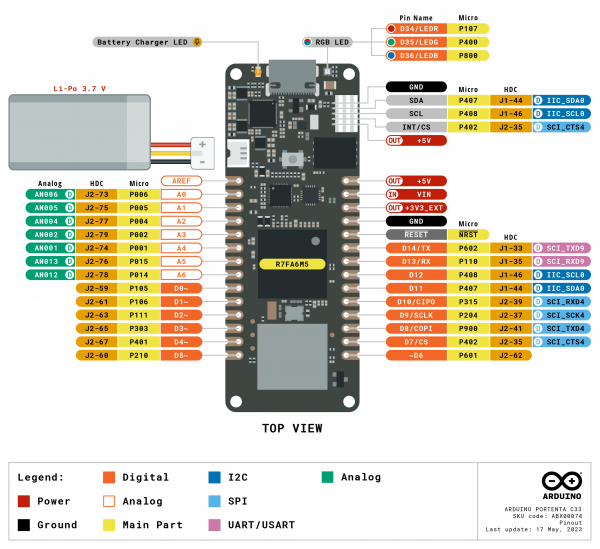
ABX00074 full pinout
Pinout · 880.8 KB · Click any page to view full size
esp32 c3 mini 1 datasheet en
Datasheet · 1.0 MB · Click any page to view full size
ra6m5 group datasheet
Datasheet · 2.9 MB · Click any page to view full size
Resources & Downloads
Guides, code examples, and more
Related Tutorials
Free step-by-step guides