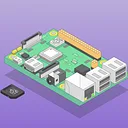
The Adafruit PiOLED is a compact 128×32 monochrome OLED display that plugs directly onto your Raspberry Pi's GPIO header. At just 1 inch diagonal, it's the perfect status display for headless Pi projects — showing IP addresses, system stats, sensor readings, or custom graphics without needing a full monitor.
The display uses the SSD1306 driver over I2C, leaving the rest of your GPIO pins free for buttons, LEDs, sensors, and other peripherals. It comes fully assembled and tested — just plug it in and install the Python library to start displaying text, images, and animations at up to 30 FPS.
Key Features
-
128×32 White OLED Pixels – High contrast, self-emitting display with no backlight needed
-
I2C Interface (SSD1306) – Uses only the I2C pins, keeping other GPIO available
-
Plug-and-Play – Pre-assembled and tested; plugs directly onto the Pi GPIO header
-
Python Library – Adafruit SSD1306 library with Python Imaging Library support for text, graphics, and animations
-
30 FPS Update Rate – Smooth enough for animations and simple video
-
Compact Form Factor – Approximately 1 inch diagonal; fits neatly inside most Pi cases
Compatibility
- Raspberry Pi 1 Model B+
- Raspberry Pi 2, 3, 4, 5
-
Raspberry Pi Zero / Zero 2 W (ideal compact pairing)
- Any Raspberry Pi with a 40-pin or 26-pin GPIO header
Ideal For
- Displaying IP address, CPU temperature, or system stats on headless Pi setups
- Compact IoT dashboards and sensor readouts
- Pi Zero portable projects and wearables
- Network status monitors and mini info displays
Package Contents
- 1× Adafruit PiOLED 128×32 OLED (fully assembled)
Resources
Jargon buster
Plain-language definitions for the technical terms used above.
- fps
-
fps means frames per second, or how many video images are captured or displayed each second. A higher fps generally gives smoother motion, which helps when the camera or the scene being viewed is moving.
- GPIO
-
General-purpose input/output pins are microcontroller pins you can set in software to read signals, switch devices on and off, or connect to peripherals. The number of GPIO pins matters because it limits how many buttons, LEDs, sensors, and other parts you can wire directly to the board.
- I2C
-
I2C is a two-wire communication bus used by many sensors and small modules. It matters because several I2C devices can share the same two wires, but each device needs a compatible address and your controller must support I2C.
- IoT
-
Short for Internet of Things, meaning physical devices that connect to networks or the internet to send data or be controlled remotely. It matters if you want projects such as connected sensors, remote controls or classroom data-logging activities.
- OLED
-
OLED stands for organic light-emitting diode, a display type where each pixel produces its own light. It matters because OLED screens are thin, high-contrast and easy to read for small status displays, but they can be more sensitive to image burn-in than some other display types.