Adafruit
FPC Breakout for Raspberry Pi 5 DSI or RP2350 HSTX
·
This compact breakout board is designed for the Raspberry Pi 5 and Adafruit RP2350 boards that use an HSTX connector. These boards use a 22-pin FPC connectio...
Get notified when back in stock
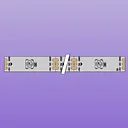
This compact breakout board is designed for the Raspberry Pi 5 and Adafruit RP2350 boards that use an HSTX connector. These boards use a 22-pin FPC connection to carry high-speed video data over differential pairs, and this breakout gives you a handy way to adapt that interface for a custom setup or another device.
With a suitable 22-pin 0.5mm pitch FPC cable, you can connect between the two boards and access the high-speed signals more easily. It brings out the four differential data channels used by the Raspberry Pi 5, or the three differential data channels used by HSTX, along with the differential clock. It also provides access to 3.3V power output, I2C, and two GPIO signals.
Adafruit has added a fairly large ground plane and aimed for clean signal routing, but this is still a high-speed interface, so signal quality can suffer if you solder on wires or run it through breadboard or perfboard. One breakout board is included; a 22-pin FPC cable is not included.
Features:
- Compatibility: Designed for use with Raspberry Pi 5.
- Compatibility: Designed for use with RP2350 boards that have an HSTX connector.
- FPC connection: Uses a 22-pin 0.5mm pitch FPC cable to connect between boards.
- Raspberry Pi 5 data lanes: Access to four differential data channels.
- HSTX data lanes: Access to three differential data channels.
- Clock: Includes the differential clock connection.
- Power output: Breaks out 3.3V power output.
- I2C: Breaks out I2C.
- GPIO: Breaks out two GPIO signals.
- Grounding: Includes a fairly big ground plane.
- Signal routing: Routed as cleanly as possible for high-speed signals.
Specifications:
- EagleCAD files: for schematic and Layout are available at GitHub.
- Tutorial: Here's a tutorial on how to read EagleCAD files with a free viewer.
- Product Dimensions: 44.8mm x 12.7mm x 3.7mm / 1.8" x 0.5" x 0.1"
- Product Weight: 2.1g / 0.1oz
A good fit for custom display, video, and high-speed interface projects where you need to break out the Raspberry Pi 5 DSI or RP2350 HSTX connection. Just add a compatible 22-pin FPC cable to complete the setup.
Jargon buster
Plain-language definitions for the technical terms used above.
- breakout
- A breakout board carries a small or fine-pitched component and brings its connections out to standard, breadboard- and header-friendly pins. Describing a part as a breakout means it can be wired into a project without soldering directly to the component's tiny contacts.
- DSI
- DSI stands for Display Serial Interface, a high-speed connection commonly used to send video data from a computer board to a display. It matters because DSI signals are not simple GPIO wires, so the cable, connector, and signal routing need to match the display interface.
- FPC
- FPC stands for flexible printed circuit, a thin flat flexible cable or connector style often used where space is tight or some movement is needed, commonly for displays, cameras and other high-density connections. Connecting to an FPC connector generally needs a matching cable with the correct pin count, pitch and contact orientation.
- GPIO
- General-purpose input/output pins are microcontroller pins you can set in software to read signals, switch devices on and off, or connect to peripherals. The number of GPIO pins matters because it limits how many buttons, LEDs, sensors, and other parts you can wire directly to the board.
- ground plane
- A ground plane is a large area of copper on a circuit board connected to ground. It helps provide a stable return path for signals and is especially important for reducing noise in high-speed connections.
- HSTX
- HSTX is a high-speed transmit interface on RP2350-based boards for sending fast digital signals such as video-style data. It matters because it uses carefully routed high-speed signal pairs rather than ordinary low-speed wiring.
- I2C
- I2C is a two-wire communication bus used by many sensors and small modules. It matters because several I2C devices can share the same two wires, but each device needs a compatible address and your controller must support I2C.
- RP2350
- A microcontroller chip from Raspberry Pi used as the main processor on some development boards. Knowing the board is built around an RP2350 helps you check software support, pin capabilities and whether it suits MicroPython projects.
Source Code
Open-source libraries, firmware & example projects for this product
PCB files for the Adafruit FPC Breakout for Raspberry Pi 5 DSI or RP2350 HSTX - 22 Pin 0.5mm
78b551a
about 2 years ago
· 2 commits
- assets cookiecutter about 2 years ago
- Adafruit FPC Breakout - Pi 5 DSI - RP2350 HSTX.brd cookiecutter about 2 years ago
- Adafruit FPC Breakout - Pi 5 DSI - RP2350 HSTX.sch cookiecutter about 2 years ago
- license.txt cookiecutter about 2 years ago
- README.md cookiecutter about 2 years ago
Related Tutorials
Free step-by-step guides