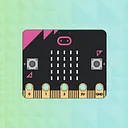
The Adafruit DragonTail for micro:bit is a fully assembled edge-connector breakout that lets you plug a micro:bit into a card-edge socket and bring every edge pad out to standard 0.1\" header pins. This makes it easy to use a micro:bit with a solderless breadboard, so you can quickly prototype circuits with sensors, LEDs, and other components without alligator clips.
Compatibility-wise, it’s designed for the BBC micro:bit edge connector and works with projects needing access to pins including I2C, SPI, and analogue inputs. It’s a great fit for breadboard-based electronics, but it doesn’t replace a micro:bit (you still need the board), and you’ll also need a breadboard and jumper wires to make connections. Some micro:bit pins are shared with the LED matrix/buttons—DragonTail’s clear pin labelling helps you pick the right pins and avoid conflicts.
Use it for classroom STEM activities, rapid prototyping, connecting servos, building sensor rigs, or driving addressable LEDs (e.g., NeoPixels) from a breadboard layout. Compared with clip-on or alligator-lead approaches, DragonTail is more reliable and gives you access to all pins in a tidy, repeatable setup—especially useful when you need the less accessible edge pads.
Suggested add-ons: a solderless breadboard like the Half-Size Breadboard and jumper leads such as Premium Jumper Wires. If you’re driving addressable LEDs, pair it with NeoPixel Strip, and for motion projects consider a Micro Servo.
Key Features
You might also like

Adafruit
Adafruit DragonTail for micro:bit - Fully Assembled
·
The Adafruit DragonTail for micro:bit breaks out all of the micro:bit's edge connector pads to standard 0.1" headers for easy breadboard use. Simply slot you...
Get notified when back in stock
The Adafruit DragonTail for micro:bit breaks out all of the micro:bit's edge connector pads to standard 0.1" headers for easy breadboard use. Simply slot your micro:bit into the card-edge connector and every pin — including I2C, SPI, and analogue inputs — becomes accessible on a solderless breadboard.
Every pad is clearly labelled with its name, analogue input capability, and whether it is shared with the LED matrix. Two dedicated power rail pads are also included. The DragonTail comes fully assembled with no soldering required.
Key Features
- Full Pin Breakout – All micro:bit edge connector pads broken out to 0.1" headers
- Breadboard Compatible – Plugs directly into a standard solderless breadboard
- Clear Labelling – Every pin labelled by name, analogue capability, and LED matrix sharing
- Power Rail Pads – Two dedicated pads for breadboard power rails
- Fully Assembled – No soldering required
Ideal For
- Prototyping with micro:bit on a breadboard
- Accessing I2C, SPI, and analogue pins not available via alligator clips
- Classroom and educational projects
- Connecting servos, sensors, and NeoPixels to micro:bit
Package Contents
- 1× DragonTail micro:bit breakout board (fully assembled)
Jargon buster
Plain-language definitions for the technical terms used above.
- breakout
- A breakout board carries a small or fine-pitched component and brings its connections out to standard, breadboard- and header-friendly pins. Describing a part as a breakout means it can be wired into a project without soldering directly to the component's tiny contacts.
- Headers
- Rows of connector contacts on a fixed pitch (commonly 2.54 mm) used to link a board to a breadboard, jumper wires, or another board. They come as male pin headers and female socket headers; when a module ships with pre-soldered headers it can be used straight away, whereas bare pads require soldering the pins yourself.
- I2C
- I2C is a two-wire communication bus used by many sensors and small modules. It matters because several I2C devices can share the same two wires, but each device needs a compatible address and your controller must support I2C.
- LED
- A light-emitting diode (LED) is a small electronic component that emits light when current flows through it in the correct direction. Because it only conducts one way, its polarity matters, and a through-hole LED must be soldered the correct way around to light up.
- solderless breadboard
- A reusable board with rows of internally connected holes for building circuits by pushing in components and jumper wires, with no soldering required. It lets you prototype and rewire a circuit quickly and reversibly before committing to a permanent, soldered build.
- SPI
- A fast serial communication bus often used for displays, memory cards, and sensors. It matters because SPI devices need specific pins for clock and data, plus a separate chip-select line for each device.
Find this product in
Brands
Related Tutorials
Free step-by-step guides