SparkFun
SparkFun Triple Axis Accelerometer Breakout - KX132 (Qwiic)
This SparkFun Triple-Axis Accelerometer Breakout is a simple Qwiic breakout for the KX132 digital accelerometer from Kionix. The KX132 is a low-power, 16-bit...
Get notified when back in stock
This SparkFun Triple-Axis Accelerometer Breakout is a simple Qwiic breakout for the KX132 digital accelerometer from Kionix. The KX132 is a low-power, 16-bit resolution three-axis accelerometer with four user-selectable acceleration measurement ranges of ±2g/4g/8g/16g and has up to a 10kHz (max) output data rate making it ideal for a wide range of acceleration measurements as well as high-speed applications such as vibration and tap sensing.
The KX132 includes a host of features including Freefall detection, Directional Tap™ and Double-Tap™ detection, tilt orientation detection and more. The Qwiic KX132 can interface with controllers using both I2C and SPI at high speeds so you can use it in an existing Qwiic/I2C chain or on a SPI bus.
The SparkFun Qwiic Connect System is an ecosystem of I2C sensors, actuators, shields and cables that make prototyping faster and less prone to error. All Qwiic-enabled boards use a common 1mm pitch, 4-pin JST connector. This reduces the amount of required PCB space, and polarized connections mean you can’t hook it up wrong.
Features:
- Measurement Range: ±2g, ±4g, ±8g, ±16g (User Selectable)
- High Resolution (8 or 16-bit)
- User-Configurable Output Data Rate (ODR) up to 25600Hz
- User-Configurable 3-stage Advanced Data Path featuring low-pass filter, low-pass/high-pass filter and RMS calculation engine
- Wide range of built-in sensing functions
- Free Fall
- Directional-Tap™ / Double-Tap™
- Device Orientation & Activity Algorithms
- Low Noise: 130µg/√Hz (varies based on ODR, power mode & other settings)
- High Resolution Wake-Up & Back-to-Sleep Detection with configurable threshold as low as 3.9mg
- 512-byte FIFO buffer that continues recording data while being read
- Selectable Low-Power or High-Performance operating modes
- Low Power with Integrated Voltage Regulator
- High Performance Operating Current Consumption (400Hz ODR + Wake-Up Detection): 148µA
- Low Power Operating Current Consumption (0.781Hz ODR + Wake-Up Detection): 0.53µA
- Standby Current Consumption: 0.5µA
- Self-Test Functionality
- Digital I2C up to 3.4MHz and Digital SPI up to 10MHz
- 2x Qwiic Connectors
- SPI available on PTH Header Pins
- I2C Address: 0x1E (0x1F alternate)
Documents:
- Schematic
- Eagle Files
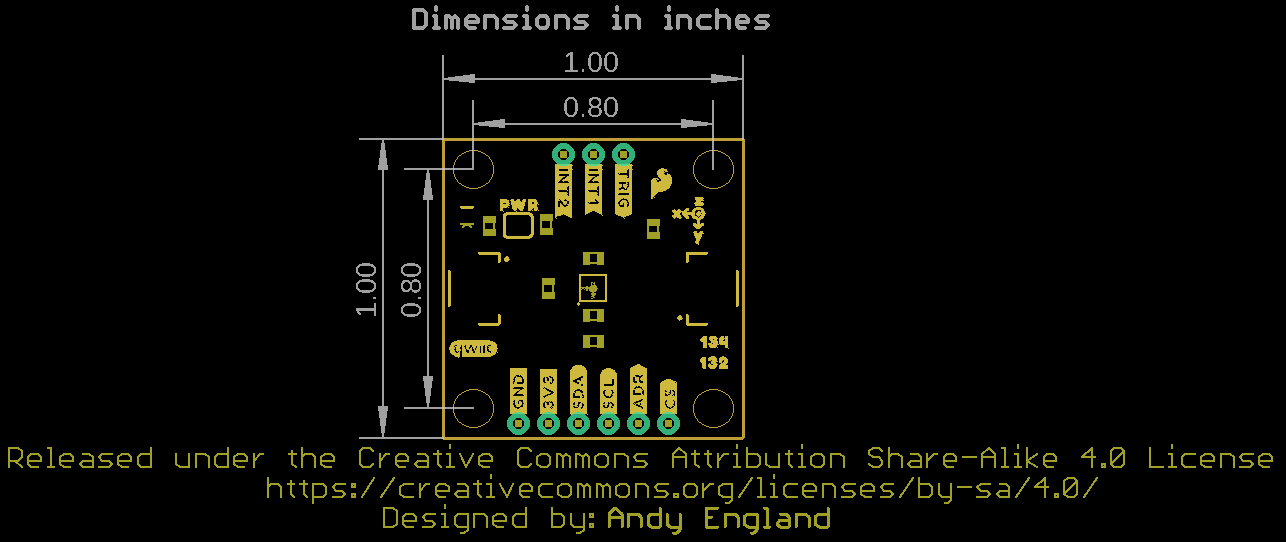
- Board Dimensions
- Hookup Guide
- Datasheet - KX132-1211
- Technical Reference Manual - KX132-1211
- AN092 Getting Started App Note
- Qwiic Info Page
- Arduino Library
- Python Package
- GitHub Hardware Repository
Videos
Jargon buster
Plain-language definitions for the technical terms used above.
- breakout
- A breakout board carries a small or fine-pitched component and brings its connections out to standard, breadboard- and header-friendly pins. Describing a part as a breakout means it can be wired into a project without soldering directly to the component's tiny contacts.
- FIFO
- FIFO stands for "first in, first out", a way of handling stored items so the oldest one is read out first, like a queue. In electronics a FIFO is usually a small buffer that temporarily holds data, such as sensor samples or serial bytes, so a processor can collect it in batches instead of reading continuously.
- ODR
- ODR means output data rate: how often the sensor produces a new measurement. A higher ODR can capture faster motion or vibration, but it usually uses more power and creates more data for the microcontroller to handle.
- PCB
- A printed circuit board (PCB) is a board, usually rigid, with etched copper tracks that connect electronic components together without loose wiring. Components are mounted on the board and signals route between them through the copper layout.
- PTH
- Plated through-hole means the pin holes are metal-lined so solder connects the pad on both sides of the board. It is useful for connectors and headers that need a strong mechanical and electrical connection.
- Qwiic
- Qwiic is a plug-in connector system for I2C devices that uses small 4-pin cables, so you can connect compatible sensors without soldering. It matters because your controller or adapter also needs Qwiic, or you will need a cable or breakout to wire it up.
- RMS
- RMS is a way of describing the effective level of an AC signal, such as an audio output voltage. It helps compare audio output levels more meaningfully than a peak voltage number.
- SPI
- A fast serial communication bus often used for displays, memory cards, and sensors. It matters because SPI devices need specific pins for clock and data, plus a separate chip-select line for each device.
Find this product in
Sensors & Input
Qwiic KX13X Schematic
Schematic · 62.1 KB · Click any page to view full size
KX132-1211 Datasheet
Datasheet · 1.4 MB · Click any page to view full size
KX132-1211 Technical Reference Manual
User Guide · 2.0 MB · Click any page to view full size
KX132 AN092 Getting Started App Note
Document · 459.6 KB · Click any page to view full size
Supplier page — sparkfun.com
Supplier Description · 596.5 KB · Click any page to view full size
Resources & Downloads
Guides, code examples, and more
Source Code
Open-source libraries, firmware & example projects for this product
527618d
12 months ago
· 133 commits
- .github Fixes accidental indent on workflow about 2 years ago
- Documentation Places new documentation in documentation folder almost 4 years ago
- examples Minor changes to SPI example about 2 years ago
- src Adds preproccesor directives to make actions happy 12 months ago
- .gitignore Adds documentation and new gitignore over 5 years ago
- CONTRIBUTING.md Add contributing, issue template, and license docs 12 months ago
- ISSUE_TEMPLATE.md Add contributing, issue template, and license docs 12 months ago
- keywords.txt Add getRawAccelRegisterData and getRawAccelBufferData over 3 years ago
- library.properties v2.0.4 over 3 years ago
- LICENSE.md Add contributing, issue template, and license docs 12 months ago
- README.md Create README.md over 5 years ago
46fd4c4
over 1 year ago
· 46 commits
- .github Update build-deploy-ghpages.yml over 1 year ago
- docs Autogenerated. Convert PyPi packaging and add Readme Updates over 1 year ago
- examples Autogenerated: Fix example bullets/markdown links over 1 year ago
- .gitignore initial commit from template over 5 years ago
- .readthedocs.yml Initial commit from template, second attempt over 5 years ago
- DESCRIPTION.rst Autogenerated: Bump version number to 2.0.0 over 1 year ago
- DOCUMENTATION.md Initial commit from template, second attempt over 5 years ago
- LICENSE Initial commit from template, second attempt over 5 years ago
- package.json Autogenerated: Bump version number to 2.0.0 over 1 year ago
- pyproject.toml Autogenerated: Bump version number to 2.0.0 over 1 year ago
- qwiic_kx13x.py Fix indentation for kx132 method over 1 year ago
- README.md Autogenerated: Update supported boards. over 1 year ago
- requirements.txt Autogenerated: Add requirements.txt for circup packaging dependencies over 1 year ago
The SparkFun Triple-Axis Accelerometer Breakouts are simple Qwiic breakout for the KX134x digital accelerometer from Kionix.
ba21595
6 months ago
· 21 commits
- .github fix issue with secrets 6 months ago
- docs fix issue with secrets 6 months ago
- Documentation Adds documentation and gitignore over 5 years ago
- Hardware Repanelizes design after fixing silk over 5 years ago
- Production Repanelizes design after fixing silk over 5 years ago
- .gitignore moved docs to gh pages and docusaurus - yay 6 months ago
- README.md Create README.md over 5 years ago
Related Tutorials
Free step-by-step guides