SparkFun
SparkFun Triband GNSS RTK Breakout - UM980
·
The SparkFun Triband GNSS RTK Breakout features the UM980 GNSS high precision RTK position module from Unicore Communications. The UM980 is a 1408-Channel GN...
Get notified when back in stock
The SparkFun Triband GNSS RTK Breakout features the UM980 GNSS high precision RTK position module from Unicore Communications. The UM980 is a 1408-Channel GNSS Receiver based on the Nebulas IV™ that is able to simultaneously track GPS L1/L2/L5, GLONASS L1/L2, Galileo E1/E5a/E5b/E6, Beidou B1I/B2I/B3I/B1C/B2a/B2b, QZSS L1/L2/L5, and SBAS. With this board, you will be able to know where your (or any object's) X, Y, and Z location is within roughly the width of your fingernail. When an RTK solution is reached, the module can achieve a horizontal accuracy of about 8mm (~0.3 inches) and vertical accuracy of 15mm (~0.59 inches). The UM980 is capable of both rover and base station operations.
We've included a rechargeable backup battery to keep the latest module configuration and satellite data available. This battery helps 'warm-start' the module, decreasing the time-to-first-fix dramatically. This module features a survey-in mode, allowing the module to become a base station and produce RTCM 3.x correction data. A SMA connector is included for a secure connection to a Triband GNSS antenna.
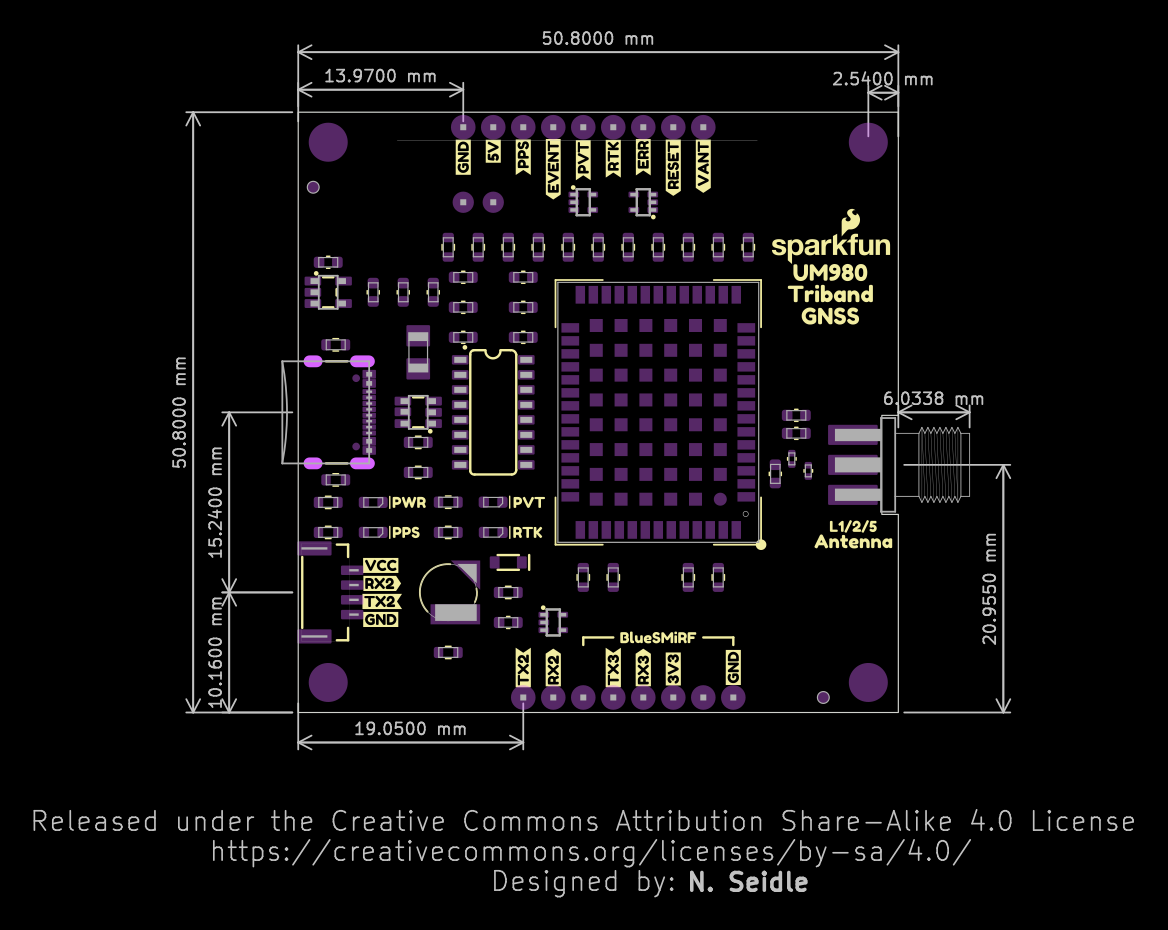
Currently, serial UART is only supported on the UM980 module. All three serial UART ports have been broken out to the USB-C connector via CH340, 4-pin locking JST connector, and BlueSMiRF header. Unique pins have also been broken out to the edge of the board. Various jumpers are also included to configure power and LEDs.
Features:
- Module has a typical low power-consumption of ~480mW
- 1408-Channel GNSS Receiver based on the Nebulas IV™
- Concurrent reception of GPS, GLONASS, Galileo, BeiDou, QZSS
- GPS: L1C/A, L1C*, L2P(Y), L2C, L5
- GLONASS: L1, L2
- Galileo: E1, E5a, E5b, E6*
- Beidou: B1I, B2I, B3I, B1C, B2a, B2b*
- QZSS: L1, L2, L5
- SBAS
- Horizontal Accuracy
- Autonomous: 1.5m
- DGPS: 0.4m
- RTK: 0.8cm + 1ppm
- Vertical Accuracy
- Autonomous: 2.5m
- DGPS: 0.8m
- RTK: 1.5cm + 1ppm
- 50Hz Data Update Rate*
- Time-To-First-Fix:
- Cold: 30s
- Warm: 20s
- Hot: 5s
- CoCom Limits
- Max Altitude: 18000m
- Max G: <5G
- Max Velocity: 515m/s
- Velocity Accuracy (RMS): 0.03m/s
- Time Accuracy (RMS): 20ns
- Supports NMEA, RTCM, and Unicore (w/ specific firmware) protocols over UART
- Integrated SMA connector for use with multiband GNSS antenna of your choice
- Voltage: 5V or 3.3V but all logic is 3.3V
- USB Type C Connector
- ESD Protection Diodes for USB Data Lines
- Built-in Resettable PTC Fuse 6V/1.5A
- CH340 USB-to-serial converter on UART1 Port
- Locking JST Connector for UART2 Port
- BlueSMiRF Footprint for UART3 Port
- Backup Battery for Hot Start
- LEDs
- PWR: Power Indicator
- PVT: Position, Voltage, Time
- PPS: Pulse-Per-Second Indicator
- RTK: Reak-Time-Kinematic Fixed Solution Indicator
- Jumpers
- SHLD: USB Shield
- VSEL: Voltage Select for Locking JST Connector Port
- PWR: Power LED
- PVT: Position, Voltage, Time LED
- PPS: Pulse-Per-Second LED
- RTK: Real-Time Kinematic LED
- BT-VCC: Voltage Select for Bluetooth Port
- VANT: Voltage Antenna Select
- Dimensions: 2.0in. x 2.0in. (50.8mm x 50.8mm)
- Weight: 13.8g
*: Items marked with * are only supported by specific firmware.
Documents:
- Schematic
- KiCad Files
- Board Dimensions
- Hookup Guide
- Unicore Communications UM980
- CH340 Drivers
- SparkFun RTK
- Arduino Library
- GitHub Hardware Repo
Videos
Jargon buster
Plain-language definitions for the technical terms used above.
- 5G
- 5G is the fifth-generation mobile network standard, offering higher-speed, lower-latency wireless data than earlier 4G/LTE networks. 5G modems can move large amounts of data over cellular networks but may draw significant current and need a suitable aerial and reliable power.
- B1I
- A BeiDou satellite signal used for standard positioning. It matters because the receiver must support the signal bands used by a constellation to take advantage of those satellites.
- B2a
- A BeiDou satellite signal used by newer dual-band GNSS receivers. Support for B2a can improve accuracy and reliability when combined with other GNSS bands.
- breakout
- A breakout board carries a small or fine-pitched component and brings its connections out to standard, breadboard- and header-friendly pins. Describing a part as a breakout means it can be wired into a project without soldering directly to the component's tiny contacts.
- E1
- A Galileo satellite signal band used for standard positioning. Knowing which signal bands are supported helps you judge compatibility and expected performance of a GNSS receiver.
- E5a
- A Galileo satellite signal band used for higher-performance positioning services. Support for E5a can help dual-band GNSS receivers improve accuracy and reduce errors from atmospheric delay.
- ESD protection
- ESD protection helps protect electronics from damage caused by static electricity discharges. It is useful on development boards because cables, sensors and modules are often plugged and unplugged during prototyping.
- Galileo
- Europe’s satellite navigation system. Galileo support can improve satellite availability and accuracy, especially when combined with GPS and other constellations.
- GLONASS
- Russia’s satellite navigation system. A receiver that can also use GLONASS has more satellites to choose from, which can improve positioning reliability when the sky view is partly blocked.
- GNSS
- GNSS stands for Global Navigation Satellite System, an umbrella term for satellite positioning networks such as GPS, GLONASS, Galileo and BeiDou. Receivers use these satellites to determine position, and high-precision units can output a steady stream of serial position data.
- GPS
- The US satellite navigation system used by GNSS receivers to calculate position and time. Support for GPS is important because it is widely available and often used together with other constellations for more reliable positioning.
- L1C/A
- A GPS signal band used by many GNSS receivers for standard positioning. Support for this band helps determine which satellite signals the receiver can use and how well it can maintain a location fix.
- L2C
- A second GPS signal band used by dual-band GNSS receivers to improve precision and reduce errors caused by the atmosphere. It matters for RTK and high-accuracy applications because using two bands can produce faster and more reliable centimetre-level fixes.
- L5
- A modern GNSS signal band used by several satellite systems for more accurate and robust positioning. Dual-band receivers that include L5 can often perform better than single-band receivers, especially for RTK and areas with reflected signals.
- LED
- A light-emitting diode (LED) is a small electronic component that emits light when current flows through it in the correct direction. Because it only conducts one way, its polarity matters, and a through-hole LED must be soldered the correct way around to light up.
- PTC fuse
- A resettable fuse that increases its resistance when too much current flows, helping protect the board from short circuits or overloads. It matters because it can recover after a fault instead of needing replacement like a traditional fuse.
- PVT
- Position, velocity and time data reported by a GNSS receiver. Knowing the PVT update rate helps you judge how often the board can provide basic navigation information to your project.
- QZSS
- Japan’s regional satellite navigation system designed to improve coverage around Japan and the Asia-Pacific region. QZSS support can improve satellite availability in supported regions when used alongside GPS.
- RMS
- RMS is a way of describing the effective level of an AC signal, such as an audio output voltage. It helps compare audio output levels more meaningfully than a peak voltage number.
- RTCM 3.x
- RTCM 3.x is a standard data format used to send GNSS correction information from a base station to a rover. It matters because both ends of an RTK setup need to understand the correction format to achieve high-accuracy positioning.
- RTK
- Real-Time Kinematic positioning is a GNSS technique that uses correction data from a base station to greatly improve location accuracy. It matters if you need centimetre-level positioning for robotics, mapping, surveying, or tracking rather than ordinary metre-level GPS accuracy.
- SBAS
- Satellite-Based Augmentation System, a set of regional services that broadcast correction information for GNSS receivers. SBAS can improve ordinary GPS-style positioning, although it is not the same as centimetre-level RTK correction.
- Shield
- An add-on board that plugs into a main controller board to give it extra features such as sensing, motor control or communication. Knowing a product supports shields helps you judge whether it can connect neatly into an existing maker-board setup.
- SMA
- SMA is a small threaded coaxial (RF) connector widely used to attach antennas and other radio-frequency cables. A device with SMA antenna ports needs antennas or pigtails with matching SMA connectors, or a suitable adapter, to connect to them.
- Survey-in mode
- Survey-in mode is a GNSS base-station setup process in which a receiver averages its own position over a set period to establish a fixed reference location. A receiver that supports survey-in can act as an RTK base and generate correction data for one or more rover receivers.
- UART
- UART is a simple asynchronous serial interface that sends data over separate transmit and receive wires, usually labelled TX and RX, with both ends set to the same baud rate. It is a common way for microcontrollers and other serial devices to exchange data.
- USB-C
- USB-C is a small, reversible USB connector that can carry power, data and, on some devices, video over a single cable. The same connector can range from charging only to high-speed data, so the functions a given port actually supports vary.
- VCC
- VCC is the positive power-supply connection on a chip or module. Connecting it to the correct supply voltage is needed for the part to power on and helps avoid damaging the electronics.
Find this product in
Brands
SparkFun Triband GNSS RTK Breakout UM980 Schematic
Schematic · 252.6 KB · Click any page to view full size
UM980 User Manual
User Guide · 1.1 MB · Click any page to view full size
UM980 General Specifications
Datasheet · 336.1 KB · Click any page to view full size
UM980 Reference Commands Manual
User Guide · 1.8 MB · Click any page to view full size
UPrecise User Manual
User Guide · 1.4 MB · Click any page to view full size
Supplier page — sparkfun.com
Supplier Description · 1010.7 KB · Click any page to view full size
Resources & Downloads
Guides, code examples, and more
Source Code
Open-source libraries, firmware & example projects for this product
An Arduino library for the UM980 and other Unicore based triband GNSS RTK receivers.
6a2198a
6 months ago
· 102 commits
- examples Update Example17_Parser.ino 6 months ago
- src Prevent out-of-bounds response[length]. Replace strtok with strtok_r 6 months ago
- .gitattributes Initial commit almost 3 years ago
- .gitignore Switch to using SparkFun Extensible Message Parser V2.0.0 8 months ago
- check.sh Switch to using SparkFun Extensible Message Parser V2.0.0 8 months ago
- CMakeLists.txt Adapted on espidf over 1 year ago
- ISSUE_TEMPLATE.md Initial commit almost 3 years ago
- keywords.txt Add getGeoidalSeparation() 10 months ago
- library.properties v2.0.1 6 months ago
- LICENSE.md Initial commit almost 3 years ago
- README.md Update README.md almost 3 years ago
Documentation and hardware repository for the SparkFun Triband GNSS RTK Breakout, featuring the UM980 high precision GNSS/RTK module from Unicore Communications
13c0f45
4 months ago
· 40 commits
- .cache Pushing Hookup Guide for Launch almost 3 years ago
- .github Update mkdocs.yml 4 months ago
- docs Update introduction.md over 1 year ago
- Firmware Update Software and Firmware Links about 2 years ago
- Hardware Update to v8. Update models. about 2 years ago
- overrides Pushing Hookup Guide for Launch almost 3 years ago
- Software Update Images and Version Number about 2 years ago
- .gitattributes Initial commit about 3 years ago
- .gitignore Ignore cache about 3 years ago
- LICENSE.md Pushing Hookup Guide for Launch almost 3 years ago
- mkdocs.yml Update mkdocs.yml 4 months ago
- README.md Update README.md about 2 years ago