SparkFun
SparkFun Qwiic Speaker Amp
The SparkFun Qwiic Speaker Amp includes the Texas Instruments TPA2016D2 stereo, filter-free class-D audio power amplifier. What distinguishes this audio ampl...
Get notified when back in stock
- Texas Instruments TPA2016D2 Stereo Class-D Audio Amplifier
- Filter-free Class-D Architecture
- Flexible Operation with/without I2C
- Programmable Dynamic Range Compression (DRC) Parameters
- Programmable Automatic Gain Control (AGC) Parameters
- Programmable Volume Control
- Selectable Gain from –28dB to 30dB in 1-dB Steps (When Compression is Used)
- Selectable Attack, Release, and Hold Times
- 4 Selectable Compression Ratios
- High PSRR: 80dB
- Fast Start-Up Time: 5ms
- AGC Enable or Disable Function
- Limiter Enable or Disable Function
- Short-Circuit and Thermal Protection
- I2C Address: 0x58 (unshifted)
- Voltage Input
- 2.5V to 5.5V via 2-pin Screw Terminal
- 3.3V via Qwiic Connector, when JP1 closed
- Low Supply Current
- 3.5mA @ 2.5V
- 3.7mA @ 3.6V
- 4.5mA @ 5.5V
- Low Shutdown Current
- 0.1µA @ 2.5V
- 0.2mA @ 3.6V
- 0.3mA @ 5.5V
- Stereo Output
- 1.7W per Channel into 8Ω at 5V
- 750mW per Channel into 8Ω at 3.6V
- 2.8W per Channel into 4Ω at 5V
- 1.5W per Channel into 4Ω at 3.6V
- 1x 3.5mm TRS Jack for Audio Input
- Screw Terminals
- 1x2 for Power Input (PWR, GND)
- 1x4 for Audio Input (GND, R, L) and SHDN
- 1x4 for Speaker Output (R+, R-, L+, L-)
- 1x 4-pin Qwiic Connector
- Built-in I2C Pull-Up Resistors (2.2kΩ)
- LED
- PWR
- Jumpers
- LED
- I2C
- JP1
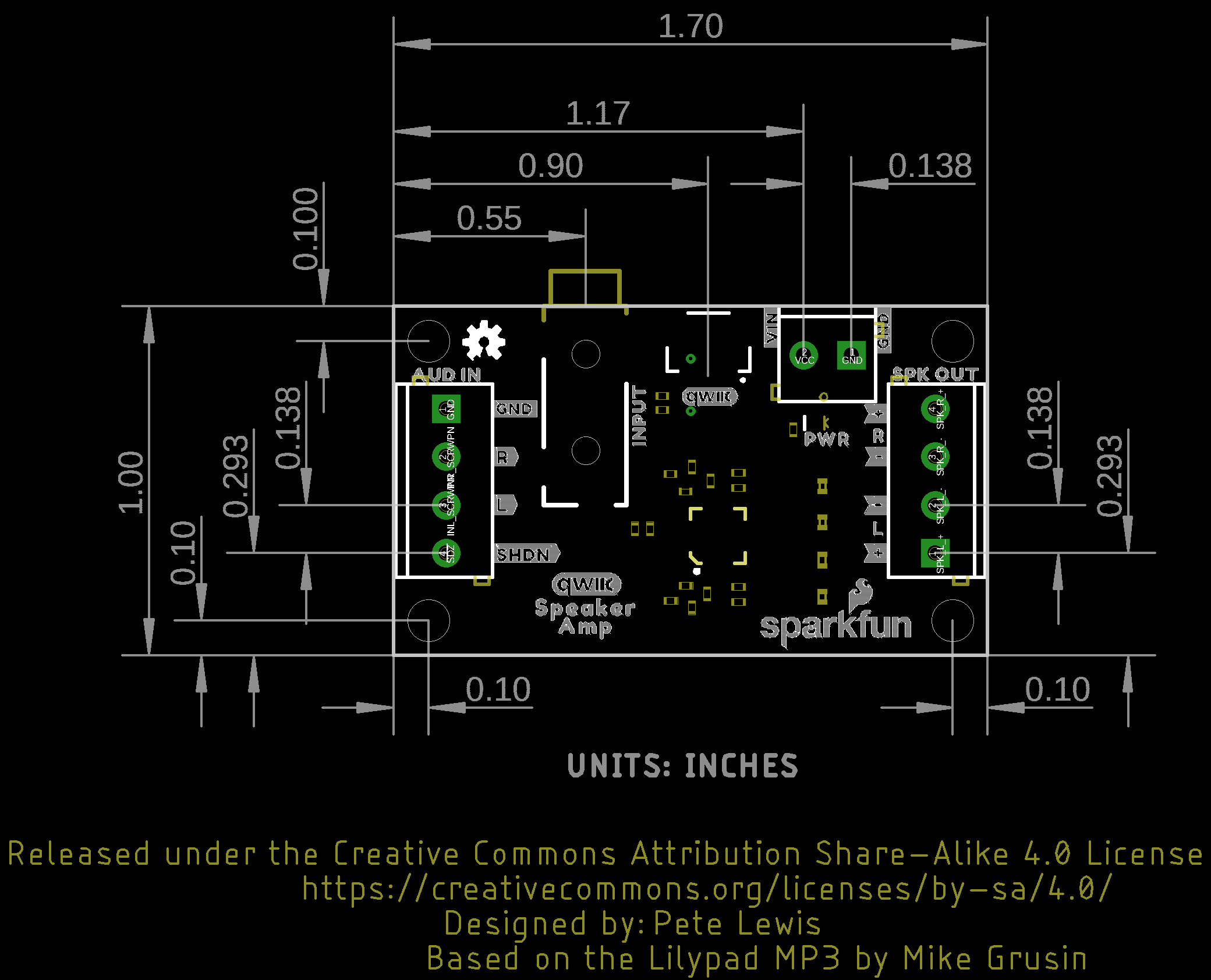
- Board Dimensions: 1.70" x 1.00"
- Schematic
- Eagle Files
- Board Dimension
- Hookup Guide
- Datasheet (TPA2016D2)
- Qwiic Information Page
- Arduino Library
- GitHub Hardware Repo
Jargon buster
Plain-language definitions for the technical terms used above.
- breakout
- A breakout board carries a small or fine-pitched component and brings its connections out to standard, breadboard- and header-friendly pins. Describing a part as a breakout means it can be wired into a project without soldering directly to the component's tiny contacts.
- dynamic range
- Dynamic range describes how wide a span of values a sensor can measure, from very low to very high. For a light sensor, a wide dynamic range means it can work in dim indoor settings as well as bright sunlight without changing hardware.
- GND
- GND is the ground or reference connection (0 V) for a circuit. When connecting two devices together, their grounds must be joined so both agree on what counts as a low or high signal.
- I2C
- I2C is a two-wire communication bus used by many sensors and small modules. It matters because several I2C devices can share the same two wires, but each device needs a compatible address and your controller must support I2C.
- I2C address
- An I2C address is the number a device uses so a microcontroller can tell it apart from other devices on the same I2C bus. It matters because two devices with the same fixed address may conflict if used together.
- LED
- A light-emitting diode (LED) is a small electronic component that emits light when current flows through it in the correct direction. Because it only conducts one way, its polarity matters, and a through-hole LED must be soldered the correct way around to light up.
- microcontroller
- A microcontroller is a small computer on a single chip that runs a stored program and controls connected inputs and outputs such as buttons, sensors, displays and communication interfaces. In a device built around one, it is the part that executes the code and coordinates the device's behaviour.
- PCB
- A printed circuit board (PCB) is a board, usually rigid, with etched copper tracks that connect electronic components together without loose wiring. Components are mounted on the board and signals route between them through the copper layout.
- Qwiic
- Qwiic is a plug-in connector system for I2C devices that uses small 4-pin cables, so you can connect compatible sensors without soldering. It matters because your controller or adapter also needs Qwiic, or you will need a cable or breakout to wire it up.
- screw terminal
- A connector that clamps bare wire using a small screw, making it easier to attach and remove wires without soldering. Screw terminals are useful for power wiring or thicker wires that are not suited to small plug-in connectors.
- Shield
- An add-on board that plugs into a main controller board to give it extra features such as sensing, motor control or communication. Knowing a product supports shields helps you judge whether it can connect neatly into an existing maker-board setup.
Find this product in
Audio & Video
SparkFun Qwiic Speaker Amp Schematic
Schematic · 177.0 KB · Click any page to view full size
TPA2016D2 Datasheet
Datasheet · 2.0 MB · Click any page to view full size
Supplier page — sparkfun.com
Supplier Description · 663.6 KB · Click any page to view full size
Resources & Downloads
Guides, code examples, and more
Source Code
Open-source libraries, firmware & example projects for this product
This repo houses all of the SFE Fritzing parts for use in diagrams in tutorials. If you create a new part in Fritzing that correlates to an SFE part, please add it here so others may use it and to avoid duplication.
71b17bb
about 2 years ago
· 339 commits
- kits Include SparkFun Inventor's Kit V4.1 almost 3 years ago
- parts Add Horizontal and Vertical Qwiic Connector and Cable to Breadboard Half (Top View) over 6 years ago
- products Update 13664_sfe_samd21_mini_breakout.fzpz about 2 years ago
- templates Renamed over 11 years ago
- License.md Create License.md over 7 years ago
- README.md Update README.md over 7 years ago
- SparkFun Plus.fzbz First Pass on SparkFun Plus bin file almost 7 years ago
- SparkFun_Plus.png Adding png for fzbz use almost 7 years ago
Arduino Library for the TPA2016D2 2.8-W/Ch Stereo Class-D Audio Amplifier by Texas Instruments.
0101960
almost 3 years ago
· 10 commits
- .github Create add_issue_to_project.yml almost 3 years ago
- examples Example 6 ready to rock about 4 years ago
- src example 5 limiter is good to go about 4 years ago
- keywords.txt example 5 limiter is good to go about 4 years ago
- library.properties initial release version v1.0.0 about 4 years ago
- LICENSE.md Example 1 and 2 working about 4 years ago
- README.md Update README.md about 4 years ago
A Qwiic-enabled breakout board for the Texas Instruments TPA2026D2 2.8W per channel Class-D stereo audio amp.
0666c55
over 3 years ago
· 23 commits
- Documents removing tpa2026d2 datasheet to avoid confusion about 4 years ago
- Hardware production panel v10 about 4 years ago
- .gitignore Initial layout getting close about 4 years ago
- LICENSE.md Create LICENSE.md about 4 years ago
- README.md Update README.md over 3 years ago