SparkFun
SparkFun Pressure Sensor - BMP581 (Qwiic)
The SparkFun Qwiic BMP581 Pressure Sensor is a standard-sized, 1in. by 1in. absolute pressure sensor breakout from Bosch Sensortec. The BMP581 boasts excepti...
Get notified when back in stock
The SparkFun Qwiic BMP581 Pressure Sensor is a standard-sized, 1in. by 1in. absolute pressure sensor breakout from Bosch Sensortec. The BMP581 boasts exceptional resolution (down to 1/64Pa) and accuracy while maintaining on-chip linearization and temperature compensation to provide true absolute data for pressure and temperature. The Qwiic Pressure Sensor communicates over I2C by default, utilizing our handy Qwiic Connect System so no soldering is required to connect it to the rest of your boards. However, we still routed the I2C signals out to a set of 0.1”-spaced pins for users who prefer a soldered connection. You can also configure the board to communicate over SPI using the same 0.1"-spaced pins.
The BMP581 has a wide pressure sensing range (30 to 125kPa) with excellent accuracy across the sensing range (± 0.5hPa (max)), as well as output data rates up to 622Hz (we have only regularly achieved 500Hz in testing, though). The sensor includes a configurable oversampling setting, FIFO buffer for storing up to 32 pressure samples, programmable low-pass filtering and even 6-bytes of user-programmable non-volatile memory. All of this allows you to customize the performance based on your application's requirements. Even without filtering, the BMP581 has very low noise (< 0.1Pa RMS).
The sensor has five operating modes: Normal, Forced, Continuous, Standby, and Deep Standby. Deep Standby consumes the least amount of current at just 1.5µA (typical) and peak current consumption by the sensor is 260µA.
The SparkFun Qwiic Connect System is an ecosystem of I2C sensors, actuators, shields and cables that make prototyping faster and less prone to error. All Qwiic-enabled boards use a common 1mm pitch, 4-pin JST connector. This reduces the amount of required PCB space, and polarized connections mean you can’t hook it up wrong.
Features:
- Supply Voltage Range: 1.71V - 3.6V
- Current Draw:
- 260µA - Max draw during measurements
- 1.3µA - at 1 Hz in Low Power Mode
- 0.55µA - Absolute minimum in Deep Standby mode
- Data Transfer Rates:
- I2C - 1MHz
- SPI - 12MHz
- 6-bytes of Non-Volatile Memory
- Pressure Sensing Range: 30 - 125kPa
- Pressure Data Resolution: 1/64Pa
- Absolute Pressure Accuracy: ±0.5hPa
- Temperature Sensing Range: -40 - 85 °C
- Output Data Rate: 0.125 - 240Hz (Normal Mode)
- Max Output Data Rate: 622Hz (Continuous Mode, 1x Oversampling)
- I2C Address: 0x47 (Default), 0x46 (Alternate)
- 2x Qwiic Connectors
Documents:
- Schematic
- Eagle Files
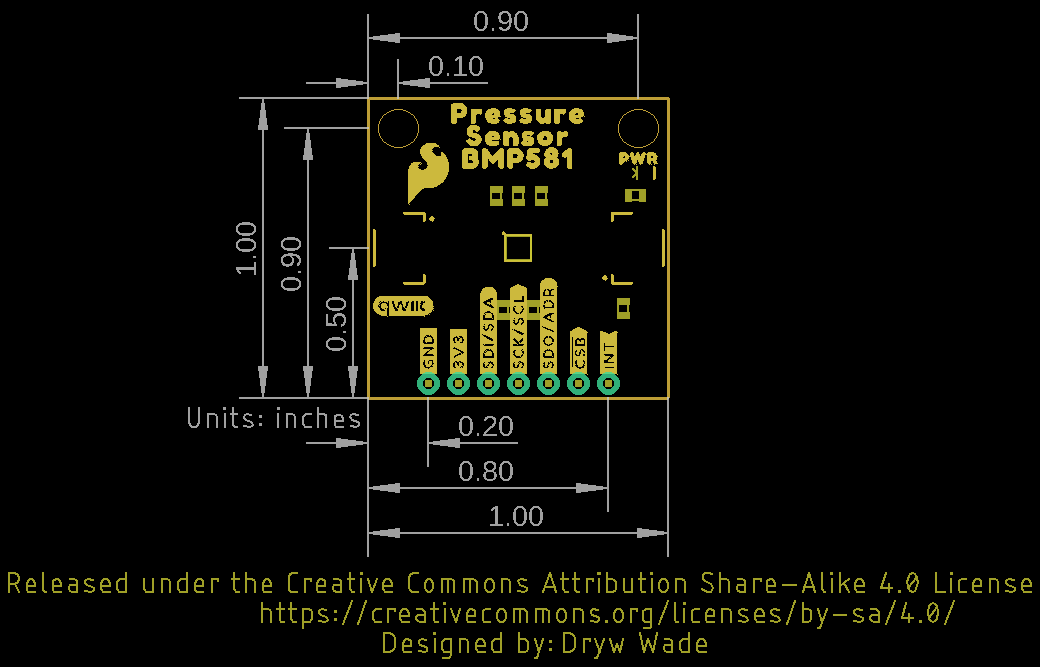
- Board Dimensions
- Hookup Guide
- Datasheet (BMP581)
- Qwiic Information Page
- Arduino Library
- GitHub Hardware Repo
Videos
Jargon buster
Plain-language definitions for the technical terms used above.
- breakout
- A breakout board carries a small or fine-pitched component and brings its connections out to standard, breadboard- and header-friendly pins. Describing a part as a breakout means it can be wired into a project without soldering directly to the component's tiny contacts.
- FIFO
- FIFO stands for "first in, first out", a way of handling stored items so the oldest one is read out first, like a queue. In electronics a FIFO is usually a small buffer that temporarily holds data, such as sensor samples or serial bytes, so a processor can collect it in batches instead of reading continuously.
- oversampling
- Taking many measurements and combining them to reduce noise and improve the stability of a reading. It matters when you want smoother current or power measurements, though it can make updates slower.
- PCB
- A printed circuit board (PCB) is a board, usually rigid, with etched copper tracks that connect electronic components together without loose wiring. Components are mounted on the board and signals route between them through the copper layout.
- Qwiic
- Qwiic is a plug-in connector system for I2C devices that uses small 4-pin cables, so you can connect compatible sensors without soldering. It matters because your controller or adapter also needs Qwiic, or you will need a cable or breakout to wire it up.
- RMS
- RMS is a way of describing the effective level of an AC signal, such as an audio output voltage. It helps compare audio output levels more meaningfully than a peak voltage number.
- SPI
- A fast serial communication bus often used for displays, memory cards, and sensors. It matters because SPI devices need specific pins for clock and data, plus a separate chip-select line for each device.
- Temperature compensation
- Temperature compensation is when a sensor or instrument adjusts its readings to reduce errors caused by changes in temperature. This matters because a sensor's raw output often drifts as conditions warm or cool, so compensation keeps readings more consistent and accurate over time.
Find this product in
Sensors & Input
SparkFun BMP581 Qwiic Schematic
Schematic · 139.6 KB · Click any page to view full size
BMP581 Datasheet
Datasheet · 2.8 MB · Click any page to view full size
Resources & Downloads
Guides, code examples, and more
Source Code
Open-source libraries, firmware & example projects for this product
073ce7c
almost 3 years ago
· 43 commits
- .github Create add_issue_to_project.yml almost 3 years ago
- examples Fix error check in low power example almost 4 years ago
- src Correct ESP32 v2.0.5 warnings-as-errors almost 4 years ago
- .gitignore Create .gitignore over 4 years ago
- keywords.txt Update keywords.txt about 4 years ago
- library.properties Bump version to v1.0.2 almost 4 years ago
- LICENSE.md Add license about 4 years ago
- README.md Update README.md about 4 years ago
6930241
over 3 years ago
· 22 commits
- Documents Add datasheet over 4 years ago
- Hardware Remove library file over 3 years ago
- Production Add production files for reds over 4 years ago
- .gitignore Add .gitignore over 4 years ago
- LICENSE.md Create LICENSE.md about 4 years ago
- README.md Update README about 4 years ago
This repository implements a Python package for the SparkFun Qwiic BMP581.
2801732
about 1 year ago
· 15 commits
- .github Update doxygen deploy branch to master over 1 year ago
- docs Autogenerated. Convert PyPi packaging and add Readme Updates over 1 year ago
- examples Autogenerated: Fix example bullets/markdown links over 1 year ago
- .readthedocs.yml Initial commit almost 2 years ago
- DESCRIPTION.rst Autogenerated: Bump version number to 2.0.0 over 1 year ago
- DOCUMENTATION.md Initial commit almost 2 years ago
- LICENSE Initial commit almost 2 years ago
- package.json Autogenerated: Bump version number to 2.0.0 over 1 year ago
- pyproject.toml Autogenerated: Bump version number to 2.0.0 over 1 year ago
- qwiic_bmp581.py Autogenerated: Convert comments to doxygen and add doxygen configs over 1 year ago
- README.md Update products in readme about 1 year ago
- requirements.txt Autogenerated: Add requirements.txt for circup packaging dependencies over 1 year ago