SparkFun
SparkFun BlueSMiRF v2 - Headers
·
The SparkFun BlueSMiRF v2 with headers is a wireless Bluetooth® serial link. These boards work as a wireless serial UART pipe and are a great wireless replac...
Get notified when back in stock
The SparkFun BlueSMiRF v2 with headers is a wireless Bluetooth® serial link. These boards work as a wireless serial UART pipe and are a great wireless replacement for serial cables. Simply pair, connect, and transmit serial data between your TX/RX lines! Any serial stream from 2400 to 921600 baud can be passed seamlessly between two devices.
Duplex transmissions up to 921600bps are supported. What does this mean? You can throw a book at each BlueSMiRF, which will correctly buffer, transmit, and deliver the data streams, byte perfect, to both radios.
BlueSMiRF v2 has a multitude of exciting improvements over the original. The BlueSMiRF pinout is the same as previous Bluetooth Mates and USB-to-serial converters (i.e., FTDI, CH340, etc.), making it extremely easy to hook up to many common Arduino development boards and high-precision GNSS breakout boards. The board can be connected directly with an Arduino Pro, Pro Mini, LilyPad Arduino 328 Main, ZED-F9P, ZED-F9R, UM980, SerLCD, or any board with a standard 6-pin serial connector. This version of the board includes a row of 1x6 male, right-angle headers. BlueSMiRF can be connected to a 1x6 female header attached to the target board or used in a breadboard. The SparkFun BlueSMiRF v2 is perfect for short-range applications up to 100ft (33m) indoors that require easy to setup, point-to-point communication.
A BlueSMiRF can be connected to a phone or computer to view data or remote control easily. Two BlueSMiRFs can also be easily connected using the onboard PAIR button. If needed, this button can be disabled by cutting the jumper on the back of the board.
We've designed the BlueSMiRF to be remotely configured from a phone using a serial terminal app. Changing the settings, such as the baud rate, flow control, and LED mode, is easily done using the simple AT command set. Additionally, Over The Air (OTA) updates using WiFi allow easy in-field firmware updates as new features are released.
The BlueSMiRF v2 has an on-board voltage regulator to power between 3.3V and 5V. Logic level shifting circuitry is included on all pins to be 3.3V to 5V tolerant. Note that you will need an RS232 to TTL converter for higher voltages. A jumper on the top of the board is also included to bypass the voltage regulator. Two built-in LEDs indicate when the BlueSMiRF is connected and when there is serial UART traffic.
Note: Bluetooth® classic (Serial Port Profile or SPP) is primarily supported. This Bluetooth protocol is supported on Android phones, most desktops, and laptops. BlueSMiRF also supports the BLE protocol, available on all Apple phones.
Features:
- Espressif's ESP32-PICO-MINI-02 Module with Built-in PCB Antenna
- Serial Bluetooth® Point-to-Point Communication
- Bluetooth Protocols Supported
- Serial Port Profile (SPP)
- Bluetooth Low Energy (BLE)
- Firmware Over-the-Air (OTA) Updates via 2.4GHz WiFi
- Recommended Input Voltage: 3.3V to 5V
- Current & Power Consumption @ 3.3V
- Idle: 72mA / 238mW
- Connected with no Serial Traffic: 75mA / 248mW
- Constant Duplex Serial Traffic: 140mA / 462mW
- AP2112K 3.3V/600mA Voltage Regulator
- Logic Level Converters on all pins
- Standard Serial Port with Built-in Right Angle Male Headers
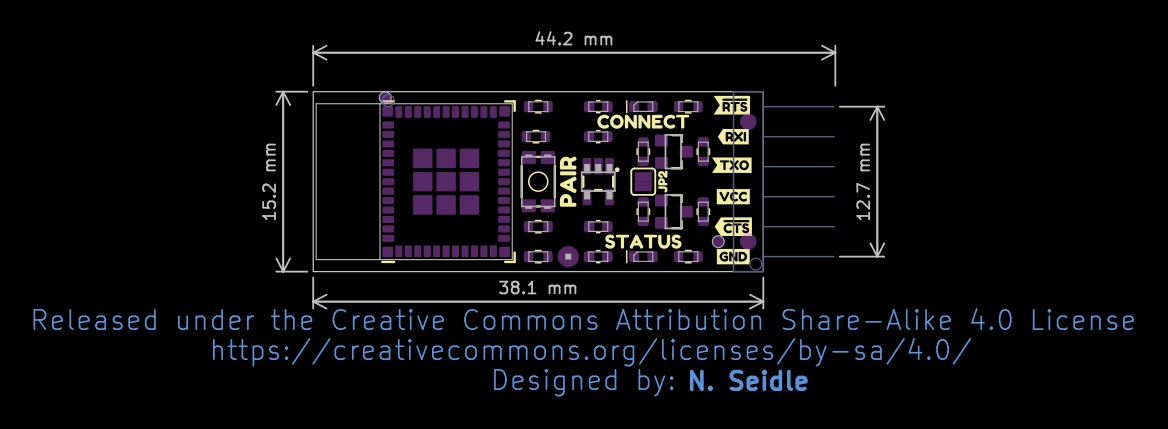
- RTS/RXI/TXO/VCC/CTS/GND
- PTH
- Reset
- Button
- Pair
- LEDs
- CONNECT
- STATUS
- Jumpers
- 3.3V Bypass Jumper (JP2)
- Pair Button (BTN)
- Pre-soldered Headers
- Weight: 3.40g
- Board Dimensions
- 44.2mm x 15.22mm
Documents:
- Schematic
- KiCad Files
- Board Dimensions
- Hookup Guide
- Datasheet (ESP32-PICO-MINI-02)
- Firmware
- GitHub Hardware Repo
Videos
Jargon buster
Plain-language definitions for the technical terms used above.
- 2.4GHz WiFi
- 2.4GHz WiFi is a common wireless networking band used by many routers and embedded devices, offering good range but more congestion than the 5GHz band. Devices on this band can join networks to transfer data or receive firmware updates.
- AP2112K
- AP2112K is a small low-dropout (LDO) voltage regulator that supplies a stable fixed output (commonly 3.3V) from a higher input such as USB 5V. Its ratings matter for checking the acceptable input voltage range and the maximum current available to the powered electronics.
- AT command set
- An AT command set is a text-based control language sent over a serial terminal to configure a device. It matters because you can change settings such as baud rate and flow control without writing custom firmware.
- baud
- Baud is the signalling rate of a serial connection, often used as the speed setting for UART communication. Matching the baud rate matters because both connected devices must use the same setting for readable data.
- BLE
- BLE stands for Bluetooth Low Energy, a Bluetooth mode designed for low power use and broad compatibility with modern phones and computers. It connects well to battery-powered and mobile devices, including Apple hardware, though it behaves differently from Bluetooth Classic and its serial-style profiles.
- breakout
- A breakout board carries a small or fine-pitched component and brings its connections out to standard, breadboard- and header-friendly pins. Describing a part as a breakout means it can be wired into a project without soldering directly to the component's tiny contacts.
- CTS
- CTS stands for Clear To Send, a serial flow-control signal that tells the other device it may transmit. It matters for reliable high-speed serial communication where buffers could otherwise overflow.
- ESP32
- ESP32 is a family of low-cost microcontroller chips and modules from Espressif with built-in WiFi and Bluetooth. They support programmable firmware and over-the-air updates, and are commonly programmed with toolchains such as the Arduino core and ESP-IDF.
- ESP32-PICO-MINI-02
- ESP32-PICO-MINI-02 is a compact system-in-package wireless module from Espressif that integrates an ESP32 chip, flash and supporting components with a PCB antenna. The exact part number helps you check its datasheet for wireless capabilities, antenna type, pinout and long-term availability.
- GND
- GND is the ground or reference connection (0 V) for a circuit. When connecting two devices together, their grounds must be joined so both agree on what counts as a low or high signal.
- GNSS
- GNSS stands for Global Navigation Satellite System, an umbrella term for satellite positioning networks such as GPS, GLONASS, Galileo and BeiDou. Receivers use these satellites to determine position, and high-precision units can output a steady stream of serial position data.
- Headers
- Rows of connector contacts on a fixed pitch (commonly 2.54 mm) used to link a board to a breadboard, jumper wires, or another board. They come as male pin headers and female socket headers; when a module ships with pre-soldered headers it can be used straight away, whereas bare pads require soldering the pins yourself.
- LED
- A light-emitting diode (LED) is a small electronic component that emits light when current flows through it in the correct direction. Because it only conducts one way, its polarity matters, and a through-hole LED must be soldered the correct way around to light up.
- OTA
- OTA means over-the-air updating, where a device's firmware is updated wirelessly rather than through a programming cable. This lets firmware be updated or maintained after a device is installed without a physical connection.
- PCB antenna
- A PCB antenna is an antenna pattern built directly into the circuit board rather than a separate metal antenna. It matters because placement, nearby metal and enclosure design can affect wireless range.
- PTH
- Plated through-hole means the pin holes are metal-lined so solder connects the pad on both sides of the board. It is useful for connectors and headers that need a strong mechanical and electrical connection.
- RTS
- RTS stands for Request To Send, a serial flow-control signal used to manage when a device is ready to receive data. It matters when moving fast serial streams because flow control can help prevent lost data.
- RX
- RX means receive, usually showing data being received by the board. An RX indicator LED can help with troubleshooting USB or serial communication.
- TX
- TX means transmit, usually showing data being sent from the board. A TX indicator LED can help you see when the board is communicating or uploading code.
- UART
- UART is a simple asynchronous serial interface that sends data over separate transmit and receive wires, usually labelled TX and RX, with both ends set to the same baud rate. It is a common way for microcontrollers and other serial devices to exchange data.
- VCC
- VCC is the positive power-supply connection on a chip or module. Connecting it to the correct supply voltage is needed for the part to power on and helps avoid damaging the electronics.
- ZED-F9P
- A u-blox GNSS receiver module designed for high-precision positioning, including RTK rover and base-station use. The exact module matters because it determines the supported satellite bands, update rates, correction formats and achievable accuracy.
Find this product in
Connectivity
ESP32-PICO-MINI-02 Datasheet
Datasheet · 926.2 KB · Click any page to view full size
ESP32 Technical Reference Manual
Datasheet · 9.7 MB · Click any page to view full size
Supplier page — sparkfun.com
Supplier Description · 1.2 MB · Click any page to view full size
Source Code
Open-source libraries, firmware & example projects for this product
A repo for all the compiled binaries, past and present, for the SparkFun BlueSMiRF products.
ac97743
over 2 years ago
· 21 commits
- bins Add CLI tools almost 3 years ago
- .gitattributes Initial commit almost 3 years ago
- batch_program.bat Add CLI tools almost 3 years ago
- BlueSMiRF-Firmware.json Github Action - Updating JSON Jan 11 2024 over 2 years ago
- BlueSMiRF_Firmware_v1_0.bin Github Action - Updating Binary Jan 11 2024 over 2 years ago
- esptool.exe Add CLI tools almost 3 years ago
- readme.md Update readme.md over 2 years ago
Documentation, firmware, and hardware Files for the SparkFun BlueSMiRF v2. These boards work as a wireless UART pipe and are a great wireless replacement for serial cables.
95392ae
4 months ago
· 174 commits
- .github Update build workflow 6 months ago
- docs Add JST variant 6 months ago
- Firmware Enable PSRAM in workflow almost 3 years ago
- Hardware Add production files 10 months ago
- overrides Add JST variant 6 months ago
- .gitattributes Initial commit about 3 years ago
- .gitignore Update .gitignore about 1 year ago
- LICENSE.md Fix docs 6 months ago
- mkdocs.yml Update mkdocs.yml 4 months ago
- README.md Add JST variant 6 months ago
- requirements.txt Update build workflow 6 months ago