Adafruit
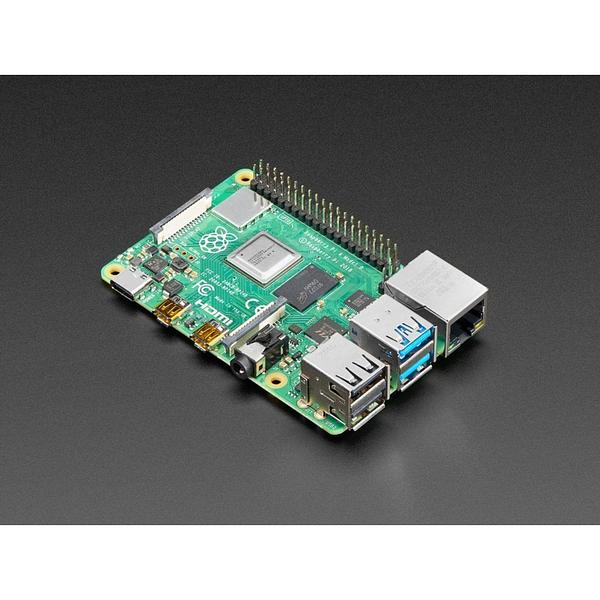
Raspberry Pi 4 Model B - 8 GB RAM
The Raspberry Pi 4 Model B is a powerful single-board computer featuring a 64-bit quad-core Cortex-A72 processor at 1.5 GHz. This 8 GB RAM variant provides a...
The Raspberry Pi 4 Model B is a powerful single-board computer featuring a 64-bit quad-core Cortex-A72 processor at 1.5 GHz. This 8 GB RAM variant provides ample memory for desktop computing, media servers, embedded development, and demanding applications.
Compared to the Pi 3, the Pi 4 brings USB 3.0 ports, true Gigabit Ethernet, dual micro-HDMI outputs supporting up to 4Kp60, and dual-band 802.11ac WiFi. The board supports Power-over-Ethernet via a separate PoE HAT.
Key Features
- Broadcom BCM2711 SoC – Quad-core Cortex-A72 (ARM v8) 64-bit @ 1.5 GHz
- 8 GB LPDDR4-3200 SDRAM – Suitable for desktop use, containers, and memory-intensive tasks
- Dual Micro-HDMI – Two displays at up to 4Kp60 with H.265 decode
- USB 3.0 – 2× USB 3.0 and 2× USB 2.0 ports
- Gigabit Ethernet – True Gigabit (not USB-bus limited) with optional PoE via PoE HAT
- Wireless – Dual-band 2.4 GHz / 5 GHz 802.11ac WiFi, Bluetooth 5.0 / BLE
- GPU – VideoCore VI, OpenGL ES 3.1, Vulkan 1.0
- Camera & Display – 2-lane MIPI CSI camera port and 2-lane MIPI DSI display port
- Storage – MicroSD card slot for the operating system
- GPIO – Standard 40-pin header, backwards-compatible with previous Pi models
- Power – 5 V DC via USB-C (minimum 3 A recommended)
Ideal For
- Desktop computing and programming education
- Media centres and home servers
- IoT gateways and home automation
- Embedded development and prototyping
- Network-attached storage and containerised workloads
Package Contents
- 1× Raspberry Pi 4 Model B (8 GB RAM)

Jargon buster
Plain-language definitions for the technical terms used above.
- BLE
- BLE stands for Bluetooth Low Energy, a Bluetooth mode designed for lower power use and modern phone compatibility. It matters because BLE support can make the module easier to use with Apple devices and battery-powered projects, though it may behave differently from classic serial Bluetooth.
- DSI
- DSI stands for Display Serial Interface, a high-speed connection commonly used to send video data from a computer board to a display. It matters because DSI signals are not simple GPIO wires, so the cable, connector, and signal routing need to match the display interface.
- GPIO
- General-purpose input/output pins are microcontroller pins you can set in software to read signals, switch devices on and off, or connect to peripherals. The number of GPIO pins matters because it limits how many buttons, LEDs, sensors, and other parts you can wire directly to the board.
- H.265
- A video compression standard, also called HEVC, that reduces video file size and bandwidth compared with older formats. It matters for vision and AI projects because hardware H.265 encode/decode support can handle many camera streams more efficiently.
- HDMI
- HDMI is a common digital video and audio connection used by computers, media players, and many displays. If a display kit has HDMI input, it is usually much easier to test with a single-board computer because it can act like a normal monitor.
- IoT
- Short for Internet of Things, meaning physical devices that connect to networks or the internet to send data or be controlled remotely. It matters if you want projects such as connected sensors, remote controls or classroom data-logging activities.
- LPDDR4
- A low-power type of RAM commonly used in phones and embedded computers. More LPDDR4 memory lets a board run larger programs, Linux services, or AI models more smoothly.
- microSD card
- A microSD card is a small removable memory card used to store files such as audio tracks. For this product, the card is where the sound files live, so its capacity and formatting can affect how many sounds you can use.
- MIPI
- MIPI is a high-speed display and camera interface often used inside phones, tablets, and embedded devices. It matters because raw MIPI displays usually need special driver hardware or software support, unlike plug-and-play HDMI screens.
- PoE
- Power over Ethernet lets one Ethernet cable carry both network data and electrical power. This is useful when installing a device where running a separate power adaptor would be difficult.
- RAM
- RAM is temporary memory used while a device is running, and its contents are lost when power is removed. A “Run in RAM” mode is useful for testing settings without permanently programming the module, but it may not support every feature.
- single-board computer
- A complete computer built onto one circuit board, usually including the processor, memory, ports, and connectors. This matters because accessories like heatsinks must match the board’s layout and mounting holes to fit properly.
- USB-C
- A modern reversible USB connector used for power and data connections. On this product it matters because it can connect directly to a computer as well as to a microcontroller project.
Find this product in
Brands
Raspberry Pi