DFRobot
FireBeetle Board-328P with BLE4.1
DFRobot FireBeetle series are low power consumption microcontrollers designed for Internet of Things (IoT) development. This Bluetooth controller combine...
Get notified when back in stock
DFRobot FireBeetle series are low power consumption microcontrollers designed for Internet of Things (IoT) development. This Bluetooth controller combines Bluetooth Low Energy 4.1 with Arduino controller, offering functions similar to the former Bluno series but with lower power consumption.
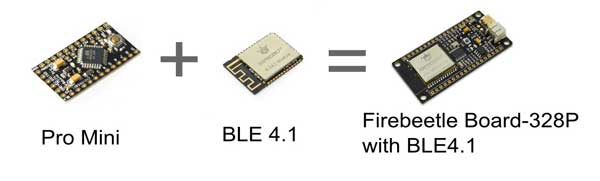
FireBeetle BLE 4.1 is compatible with Bluno series (BLE 4.0) and performs much better. It equipped with more stable DIALOG Bluetooth 4.1 chip, supporting maximum 4Kbyte/s transmission rate and low power consumption (25uA POWER DOWN). It can be directly applied to low power consumption application such as wearable and intelligent tools and so on.

It also supports multiple Bluetooth cascade, KISS connection (approach connection) and compatible with Bluno series. Its connection can be realized by holding host BOOT and moving to the target peripheral device.
FEATURES
- Support Arduino IDE program
- Support BLE 4.1 central and peripheral switch
- Support Bluetooth serial port data transmit
- Support Bluetooth peer to peer (P2P) wireless programming
- Support Bluetooth 4.1 multiple device cascade (maximum:4)
- Support Arduino Bluetooth library (support multiple Bluetooth connection)
- Support low power consumption Bluetooth (standby current: 25uA; enabled interrupt current: 70uA)
- Double interruption to wake up:
- BLE4.1 awake Atmage328P by D2 (high level awake)
- Atmage328P awake BLE4.1 by D3 (low level awake)
- Support KISS connection (approach connection)
- Support Bluetooth firmware update
- Support USB charge
- Support lithium battery power supply
- Equipped with status LEDs
SPECIFICATION
- Processor: ATMEGA328P
- Bootloader: Arduino Pro or Pro Mini, ATmega328 (3.3V, 8MHz)
- Operating Current: 3.3V
- VCC I/O Voltage: 3.7V~5.5V
- Lithium Battery Voltage: 3.7V
- Support maximum 4Kbyte/s transmission rate (more device, lower rate)
- Support low power consumption: 25uA (POWER DOWN); 70uA (enabled interruption)
- Support maximum discharge current: 600mA (LDO-3.3V OUTPUT)
- Support maximum charge current: 400Ma
- Digital Interfaces: 14
- Analog Interfaces: 6
- SPI: 1
- I2C: 1
- UART: 1
- LED_BUILTIN: D13
- Interface Mode: 2.54mm (Pin/Female header), soldering free in default
- Dimension: 58 * 29 mm/ 2.28 * 1.14 inches
DOCUMENTS
Jargon buster
Plain-language definitions for the technical terms used above.
- ATmega328P
- An 8-bit microcontroller chip used on many Arduino Uno-compatible boards. Knowing the controller uses an ATmega328P helps you understand its memory, speed, pin compatibility, and the Arduino sketches it can run.
- BLE
- BLE stands for Bluetooth Low Energy, a Bluetooth mode designed for low power use and broad compatibility with modern phones and computers. It connects well to battery-powered and mobile devices, including Apple hardware, though it behaves differently from Bluetooth Classic and its serial-style profiles.
- Bootloader
- Small starter software on a microcontroller that lets new code be uploaded before the main program runs. Knowing how to enter bootloader mode matters when you need to program the board or recover it after a faulty sketch.
- I2C
- I2C is a two-wire communication bus used by many sensors and small modules. It matters because several I2C devices can share the same two wires, but each device needs a compatible address and your controller must support I2C.
- IDE
- Short for Integrated Development Environment, a program used to write, run and manage code. It matters because some learners prefer a traditional coding workspace instead of a guided notebook-style lesson.
- IoT
- Short for Internet of Things, meaning physical devices that connect to networks or the internet to send data or be controlled remotely. It matters if you want projects such as connected sensors, remote controls or classroom data-logging activities.
- SPI
- A fast serial communication bus often used for displays, memory cards, and sensors. It matters because SPI devices need specific pins for clock and data, plus a separate chip-select line for each device.
- UART
- UART is a simple asynchronous serial interface that sends data over separate transmit and receive wires, usually labelled TX and RX, with both ends set to the same baud rate. It is a common way for microcontrollers and other serial devices to exchange data.
- VCC
- VCC is the positive power-supply connection on a chip or module. Connecting it to the correct supply voltage is needed for the part to power on and helps avoid damaging the electronics.
Find this product in
Connectivity
DFR0492 fireebeetle ble4 1 board datasheet v1.0
Datasheet · 5.1 MB · Click any page to view full size
Resources & Downloads
Guides, code examples, and more
Related Tutorials
Free step-by-step guides